Showing posts with label London. Show all posts

3 Mar 2022

nocturne number 2

It's been a while since my last nocturnal walk around the city. What was a first though, was joining a group of other photographers on the adventure. I've always felt a little superior to the pack approach, playing on the lone wolf stereotype, but this taught me not to be so precious. It was really interesting to look through other people's eyes on the same scenes when we shared our work with the wider LIP group. 

 Watling Street

Gough Square

 Ludgate Circus

In addition the walk was well structured by Dan Dodman to reference points of historical note en route, so it brought together two of my passions. The only downside to the evening was my failed attempt to pirouette some street furniture in the dark. Ouch.

My slalom metaphor suddenly seemed very apt. 


12 Feb 2022

shifting plates

Well just adding this image to the page gave me a thrill. It's been a while.... 

 London Contact Sheet 2021

Back last summer I, ironically of course, posted an image of an exposed roll of film, the result of a wander around London's West End for the first time in a long time. Well plus ça change. True to form it's taken my usual gestation period for the images to see the light of day again. 

The style hasn't materially changed either. I've written at length about that and also how I'm at a point of reflection now too, but it was good to just reconnect with those familiar streets. Nothing's fixed in time of course. 

They shift beneath my feet, now more than ever.


6 Jun 2021

remember this?

I've celebrated my own return to normal this week. Back in the West End with a camera - not a phone - using film - not digital - in black & white - not..well you get the picture.

Iford film canister

It was a poignant moment. Lockdown has really made me consider my practice of street photography. I'm more conscious of the privileges I have to work in the way I do. Ethics are implicit too.

However I confess that feeling, giddiness even, of giving yourself to the moment, going with the flow, getting in the zone, is still as strong as ever.

Is it too late to change my style now? Is muscle memory too dominant? I have to ask why do I still plough this furrow, like a lounge musician still playing the standards, after all these years. My answer has been simple, a little pompous. It's because I have to. But I don't think that cuts it today. My Living Lockdown project has been about using that privilege to give back. Maybe that's the way forward, my own new normal.


9 Nov 2020

london's dreaming

It's the start of the Second Lockdown.
 
For the only the second time since March I'm in the West End. 
 
I really feel I am literally going through the motions of being in the city. 

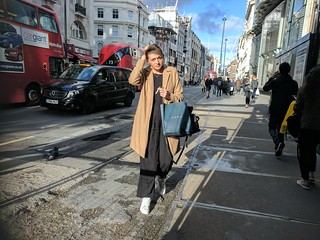
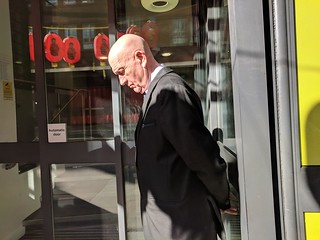
woman on Shaftesbury Avenue


Following one of my usual paths, along Piccadilly to Leicester Square and into Soho, emotionally and mentally it's not the same place. I could expect that. 
 
But the absence of its physical nature strikes me more.  
 
Wariness of our proximity to others feels like it's becoming second nature but it's not ...natural. 

cinema on Rupert Street 
 
The fabric of the city is beginning to rent, making manifest the mood of temporality. 
 
Don't get me wrong. Decay and renewal is part and parcel of the life of the city, a reflection of life lived. This is different. 
 
This is more about neglect and rejection. 

Shop window Piccadilly\


A brokenheartedness.


20 Aug 2020

take a walk on the southside

Books - as well as virtual tours - are a great resource for me right now so I was so pleased to see Paul Treacy had created another wonderful handmade book of his life in south east London.


I've written about his work a couple of years ago when he published SE26. I suppose it's one of the benefits - for me at least - of this blog that I can take time travel back to my state of mind over the last ten years and in a way a long time before that too.

I was thinking then of my roots and that concept is very much back on my agenda, courtesy of our current hyperlocal lifestyles. I identify with London, of being a Londoner. Although I'm not quite sure what that means right now. Where I was born in an area of south east London - not central, not suburban - gave me an outsider's perspective of the city. Reinforced to a large degree by my parents' status and a big motivation behind my photography. I've since started to appreciate where I live now in west London over the last few months....again through the medium of photography. 

The outsider-ness is still present (I blame reading French existentialism at an impressionable age) so maybe that's here for good now but to be honest I feel I need to dig a bit deeper, beyond my surface and that of the world around me. The New Europe project was a step in that direction. 

I need to keep walking. 


15 Mar 2020

more distance between us

It seems timely to revisit a book I put together a few years ago called Distance Between Us. The images I chose illustrated my love of city life: the democracy of public space (the civilisation of civic space?). Moments where we share intimate proximity with strangers, creating serendipitous relationships on the wing. 
At least that's what we used to.
The current coronavirus crisis has meant fundamental changes to our daily interactions with each other. A new phrase social distancing has entered the language. It's a fascinating and terrifying concept. It arguably strikes to the heart of our lives as citizens. We take freedoms of association and movement so easily far granted in what I'll call liberal democracies. Well this is a global crisis with lives of millions of people at risk (not forgetting the other one). Rome, Madrid and New York are already under states of emergency. Paris, Amsterdam, Dublin and Berlin limiting public gatherings. The very fabric of city life has disappeared overnight.
London waits.
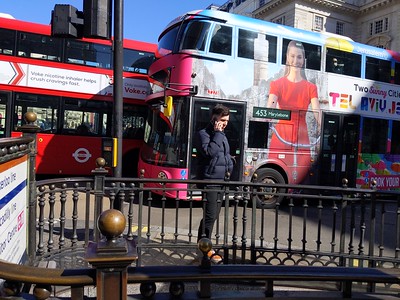
man at Piccadilly Circus
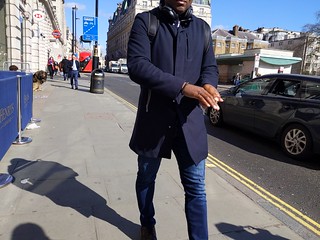
man on Piccadilly 
Earlier this month I was at a strangely empty Photographers Gallery. Ten days later I wonder when I'll next be at an exhibition, performance or indeed any public gathering. I was there to see four nominees for the Deutsche Börse prize and admired the multidisciplinary approach of Mohamed Bourouissa including a piece of augmented reality.
London street image
Reserve army of the unemployed, Mohamed Bourouissa
The comparison with these shrouded figures to the images we're seeing daily of  health workers clad in hazmat suits was powerful. Seeing them materialise in the gallery, silently observing our entitled behaviour, revealed the surrealism of our situation. It's a rude awakening.


8 Mar 2020

eyes of Dora Maar

I'm really glad I made it to the Dora Maar show at Tate Modern before it closes as, once again, my eyes were opened to another photographer who excelled at candid photography in the midst of social change.
Maar's story goes well beyond her trip to London in the 1930s so this work is very much a moment on her path to her better known life as a surrealist, encompassing photomontage, painting and poetry, but for me it was a fascinating example of little-known street photography - being outside the canon, obvs - that even in the few images in this show really gave me some small insight into her thoughts and motivations 
The portraits in London are very much rooted in their environment. We see individual hardship in the shadow of the bricks and mortar of questionable financial probity. I hadn't seen an image of a pearly king in years and Maar's photographs really made me think of the historical representation and reality of English working class culture. 
No dole - Work wanted - Lost all in business, Dora Maar, 1934
Pearly King collecting money for the Empire Day, Dora Maar, 1935
There's a mood about them, and her other photographs from the streets of France and Spain in the same period, that for me has more of an edge than the French humanist style of that time, feeling more affinity with the emerging American outsider. They reflect the social context of the times through the idiosyncratic, compassionate eyes of the photographer. Timeless in lots of ways.

31 Jan 2020

eyes on the street

The announcement by London's police force that it will use live facial recognition reminded my of a book I published a few years ago called Street View People View
link to People View Street View book
The arguments against it are essentially the same (although the quality of the technology is still moot) but what's changed is the sense of threat to personal safety on the streets of London. It's well documented that London is, outside China, the most cctv'd (if that's a word) city in the world which I think has normalised (not a nice word) surveillance here. I'm certainly conscious of its absence when I visit other cities around Europe.
I'm also conscious that street photography is itself a form of surveillance. I've excused myself with the well worn argument that anyone - voluntarily - in a public space is open to being photographed. I must admit even writing this now makes me stop and think. I find myself thinking of clauses like some dodgy small print. 
My pictures take months to produce so I don't share them randomly with my thousands (sorry, tens) of followers 
They are on film so there is no exif data of specific time and place 
People are in my pictures but the subject is the city 
It's not about you...it's about me 
etc etc 
Figure on Oxford Street
I acknowledge my work is becoming more anachronistic the longer I pursue it. The universal truths of earlier practitioners appear naive or repressive now. Street is still a valid form but it needs to reflect the present to work best, as it's always done. The New Europe project is my attempt to address that. It's given me greater motivation and purpose. It's also given me something else.  
Empathy.

14 Nov 2019

southam street blues

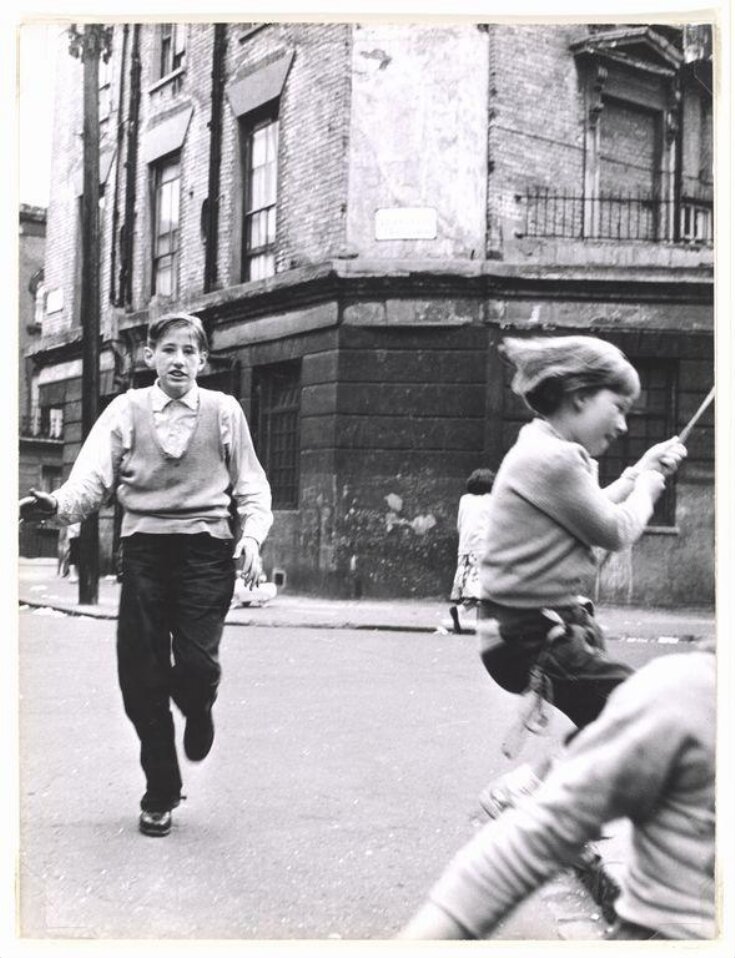
I've known the powerful images from Roger Mayne's Southam Street series for a long time and was honoured to be shown in his company at the survey of London Street Photography show a few years ago. Made at a time in London's history when my parents had arrived to be confronted by a culture of "No Blacks, No Dogs, No Irish" his pictures have a social context that give them an added edge for me. I had a real thrill when - oh what's that word? Oh yes - serendipitously, I came across the street sign while out walking beneath Trellick Tower, one of my London icons.
London street image
Southam Street, W10, Roger Mayne
I say sign because the fabric of the street has all but disappeared save two buildings looming like Warner Brothers film lot facades. Those terraces and sounds can now only be experienced in social documentaries of the era. I know I'm in danger of a nostalgia wallow - which could be said of my whole practice -  but it's interesting to read Mayne's own words from 1959,
The reason for photographing poor streets is that I love them. Empty, the streets have their own kind of beauty, a kind of decaying splendor and always great atmosphere - whether romantic on a hazy winter day, or listless when the summer is hot; sometimes it is forbidding; or it may be warm and friendly on a sunny spring weekend when the street is swarming with children playing, or adults walking through or standing gossiping. I remember my excitement when I turned the corner into Southam Street, a street I have since returned to again and again. 
It's hard not to avoid a comparison with Cartier-Bresson's privileged upbringing and subsequent love of photographing everyday life. Granted having the time and money to pursue this way of working for its own sake was - and arguably still is - a characteristic of street photography but should it have any bearing on judging its merit from our perspective? 
I'd go back to my opening point that I take as much from the social context of street images as their own composition. You could say that's not untypical of any photography but for me it's particularly relevant to street which by its nature is a real time reflection of both the location of the photographed and the culture of the photographer.
London street image
So where are the Southam Streets of today? Well there are still plenty of poor streets but people are now documenting their own lives, spending as much time on written narrative as the image. Jim Mottram and Paul Sng are two notable examples and I'd also include James Hopkirk too. 
The images speaks with originality and energy, giving insight into worlds too easily neglected. The photographer here is no longer bystander or daytripper but implicated and yes exposed by the work.
I was on that journey too once upon a time. Time bends.


21 Sept 2019

last roll of the dice

It's September and both my film stock and opportunities to photograph diminish with the sun getting lower in the sky. 
London street image
It's been a fascinating and frustrating season. 
For good or ill we're now getting used to sunshine rather than rain in London. It's reflected in abundant street life especially as the city's tube experience flushes people above ground. My beat of Oxford Street, Piccadilly, Regents Street, Charing Cross Road and The Strand is still as busy as ever. 
However New Europe has changed my patterns of when I'm active, now not as interested in the early morning/late evening moments of high-lit individuals silhouetted or squinting. I'm now as interested in the context of the street around those figures, the billboards and the buildings. It's already reflected in my pictures. They've lost that immediate impact (I missed my moment with Instagram) and they now require a little more time to reveal themselves, often not individually but collectively too. 
London street image
I'm looking forward to discovering what pictures I actually made this summer. It's a nice time when everything is possible. It's mysterious and magical. I feel like a big kid. But then again. Maybe I am.

13 May 2019

first shoots

My first crop of work from this season includes pictures from Berlin. It was a flying visit so having the framework of New Europe in my mind was a useful focus, as much as in my contact sheet editing as on the street. It's a tricky balancing act. I've shied away from looking for pre-meditated - as much as anyone can - pictures but I think I've found a position that creates the possibility of pictures that still have my beloved ambiguity without being too didactic.
Anyway. I'll let you be the judge.  
Willkommen to my world.
link to New Europe photograph
link to New Europe photograph 
link to New Europe photograph
Now I feel ready to add these to the ongoing zine project. 
I'm looking forward to some cool origami action.
.

11 Apr 2019

looking at me?

In vain I'm trying to control my collecting of books, in particular ones which reflect city street life, especially London, so I try to choose ones with an original take. I'm pleased to say Nigel Shafran's The People on the Street is one of those.  
Like a lot of great ideas, it's very simple. It's becoming more common to encounter homeless people on the street. For me they have no choice in the matter so I don't purposely take pictures with them as a subject, however in its own way that's ignoring their existence. There's already an argument that self censorship in this way will mean future generations won't have a record of children on the street so I like seeing projects where they can document their own lives. Following similar logic Shafran empowers homeless people by giving them a camera to take pictures not of themselves but of himself.
People on the street book cover
The resulting book is a powerful commentary on a societal responsibility but also, if it's not too indulgent, on documentary photography itself. There's an important debate about the best photographic practice in documenting people's lives all around the world which doesn't simply objectify them or worse. We're not now living in a time where Life or National Geographic ran photo stories of exotic other worlds, reinforcing stereotypes of difference, and yet that form of representation is hard to shake off. Homeless and, more broadly, other disadvantaged people occupy a similar status of otherness in this country today whether that's a kind of "by the grace of god" or "it's their own fault" attitude. It's worth mentioning two other current UK photography projects that directly address this, J A Mortram's Small Town Inertia and Paul Sng's Invisible Britain. Not worthy or patronising photographs. Work that's part of a broader context of social engagement and change. Inspirational stuff.

26 Feb 2019

the day the earth

The sun's splitting the stones in London and I'm torn. Sun is the prime ingredient of my photography. So what's the problem? It's February and I'm out on the streets, a month ahead of schedule. That's the problem. 
I confess I'm already uncomfortable with the environmental impact of using film. Now I'm facing up to fact I'm literally fiddling while the world burns. Movies set in the future but made in sixties had a big impression on me, especially, no surprises, ones set in London.
Now I'm wondering if my work is becoming more like a nature documentary. The sun is so strong yet still low in the sky. Shadows are still relatively cold. People wear sunglasses, shorts...and scarves. We're in the headlights. Transfixed by the sun, knowing the danger but compelled to stare. 
London 2019
Oh yes and London had a high pollution alert today. Apart from the risks posed by couriers, security guards and manhole covers I do wonder if particulate exposure is an occupational health hazard of street photography. That's if the sun doesn't get us first.. 
Stay safe. 


12 Dec 2018

power of love

I've neglected writing about my roots for a while now. Granted they're bubbling beneath my current project but the death of my mum almost two years ago seems to have consciously or not put that to one side. In fact that's the subject of a blog post that's been in draft for over a year now following my discovery of a wonderful book by Paul Treacy called SE26 at the 2nd London Photography Symposum.
Paul lives in a part of south London my mum spent her last weeks in. The photographs that make up his book are, for me, a beautiful and evocative reflection on the time I spent with her in and around that area. It's a special book even without the connection I made to it as it's a portrait of a neighbourhood as lived in by the photographer. Each image stands alone but you can appreciate it is part of a larger experience and set of narratives you're privileged to glimpse into and wonder about.
In the serendipitous way I love life works my interest in anything street was piqued by the publication of How Graffiti Saved My Dad's Life. It's both an important document of contemporary social commentary across the landscape of London and a love letter from a daughter to a father commemorating celebrating his passion and her efforts to sustain it through his terminal illness.
Colossive Pres
I found the story an inspirational illustration of how pictures can act as a bridge between different worlds on so many levels and to its viewers in so many different ways. What's that sound? Ah, just another echo of Ambiguous.
My own connection was that while reading the book it became evident that the wonderful photographer was in the same hospice as my mum at around the same time. It gave me an illogical sense of comfort and a reconnection with both the power of photography...and the power of love too.

30 Nov 2018

nocturne

I've eased the transition to post-season by going to some talks by photographers about their practice. Being me there's a London angle to them of course. 

I welcomed the opportunity to revisit the London Nights show at the Museum of London. Both it and the talk gave me such inspiration I was propelled into the streets outside. There's a tension in my relationship with the City. I love the diversity of the West End versus the homogeneity of the street life of the square mile however I can't deny a fascination with its historical context. To that end it was inevitable I was drawn to an icon of the show, St Paul's Cathedral.
It's hard not to look at the image of St Paul's featured in the show in the midst of the Blitz by Herbert Mason in the context of today's debate about Britain's role in the world. It's suffused with a sense of standing alone against European tyranny and it's propaganda value is just as powerful today as in 1940. So it was with fascination I found in its grounds a funfair that had been installed for the Lord Mayor's Show that weekend contrarily, or perhaps not, shared with the 100th anniversary of Armistice Day.
St Paul's photograph
The carousel's seats, occupied by cut-out figures swaying lifeless in the wind and rain presented too easy a metaphor for the current political climate. However the role of the night was the dominant feeling for me. The darkness accentuated the spot-lit dome like a surreal inverse of a wartime blackout. The only sound was of the wind through the carefully placed trees. The amusements observed their own embarrassed silence, knowing it wasn't the time or the place to hook a frog, prize every time.  
All these sensations were in stark contrast to my daytime experience of London and they were brought to the surface again thanks to another night-time talk, this time on the other side of the City in Aldgate. 
After hearing Tom Hunter passionately give London Independent Photography's annual talk (reminding me of another Hackney advocate) I was drawn to wander the streets outside around Petticoat Lane in the shadows of the office blocks and converted warehouses of Bishopsgate. 
Petticoat Lane photograph
Despite the encroachment on all sides those streets still bear some testimony to another London. One well documented by some of my favourite photographers so there was undeniably a feeling of nostalgia but also one of embracing the future. As much as these new buildings represent life for the few not the many London, indeed any city, is constantly in flux.
Like months to a flame people are drawn here.

21 Jun 2018

always first steps

I'm really enjoying my participation in the my local London Independent Photography group. I'm in my second year which feels like a (small) achievement after previous failures to commit to group photography projects.
As well as showing and discussing photography the group is actively involved in local exhibitions. Last year's group show had a really interesting theme and this year's is just as good. So good I've ended up in the team organising it!
Oblique Strategies is an approach that Brian Eno and Peter Schmidt evolved in the 70s to overcome creative blocks. I remember interviews with David Bowie talking about his writing technique of cutting up words so it was fascinating to see how this had been formalised, industrialised even, into a process and used on his Berlin albums produced by, guess who, Brian Eno.
Each of the group were drawn a statement from the set of Oblique Strategies to respond to with a photograph. Always First Steps was mine. Well how easy was that going to be? Despite an aspiration to try different techniques by joining the group I do find myself back in my safety zone. So how about a blur of shoes on Waterloo Station's Odessa Steps? Perhaps a crowd crossing Oxford Circus Shibuya-style? Over complicating it? OK then, a kid on reins. Job done.
Well not quite. 
To do justice to the project - and Brian and David too - I felt I needed to dig a little deeper. One of the many exciting aspects of talking photographs on the street is, one of my favourite words, serendipity. That moment when two, or more if you're especially fortunate, elements come together. They are rare but incredibly rewarding. 
So what did I come up with? 
This.
link to Venice images
The reason why I don't title any of my pictures is just to let people read whatever they want into them. It was one of the motivations for The Ambiguous Project!
It's fascinating showing this image to people, revealing the "title" and listening to their interpretation. I'm sure there's some psychological process at work here. The same way perhaps we make connections between images and soundtracks we need to rationalise what we're seeing, no matter how arbitrary. To achieve dissonance is a real challenge. Aha. 
I feel another project coming on...


30 May 2018

city of stars

Wonderful to see London Nights a new photography show at the Museum of London. I really think it's my favourite museum and it was an honour to show my work there in the survey of London street photography. There's a strong thread of street in this show...from times way before the phrase had been coined so it's a great opportunity to look at those photographers and their work.
I was really pleased that the exhibition lead with a photograph by Paul Martin. I first became aware of his work courtesy of the show I mentioned above and he's a real pioneer of this form of photography. Well worth looking up. It was great to discover another "unknown" Mercie Lack. Details of her photography are scant - as are much about her life - so it's great to find an audience for her work in the 21st century which can admire her work both creatively and politically. I'd love to see her story developed.
Mercie Lack's Late Extra
              Late Extra, Mercie Lack
There's so much to see at the show and it's achieved by a feat of curation by Anna Sparham. More well known work by Bill Brandt has to be included and rightly so but I appreciated the chance to see more contemporary work and the use of film and video too. Rut Blees Luxemburg's piece London/Winterreise, 2013 is a salutary reflection on the state of London today referencing classical architecture and music. Inspirational. 
link to Tokyo night image 
The show challenged me directly too. I've taken night time pictures in other cities but why not London? Am I too obsessed with my daytime practice? The 360 work I made - interestingly enough also in Tokyo - was a step towards a new form of expression. Well maybe it's time for my own Winterreise moment.

10 Apr 2018

dear, damned. deceptive city

I'm always on the lookout for photography books about cities - London in particular of course - so I was really pleased to discover both a wonderful book and a photographer I'd known nothing about. It affirms my faith in the photobook as a 
Londýn 60. let / Sixties London by Miloň Novotný affirms my faith in the photobook as not just a nostalgic trip to the past or an arms length glimpse of a  another world but as much a reflection on our own place and times. I found myself visualising the exact spots where Novotný would have stood in Picaddilly Circus, Tottenham Court Road or Cornhill. Reminds me of the Street Museum idea that I still would love to do something with. Oh dear. Too late.
Milan Novotny's londyn 60. let review 
For me there's a connection to the work of Markéta Luskačová and Sergio Larraín which makes it all he more interesting, a kind of cross referencing of people and place with the eyes of a outsider.
Social class as explicitly referenced in the photographs of the City and the East End is a common denominator but so is the less stratified world of the West End. It resonates with me as I've always enjoyed the social mix drawn by the shops, businesses and tourist attractions there. The City has some of that and arguably the East End is on its way. Maybe it's the South Londoner in me that's behind this so I love to see how photographers from different backgrounds approach the city.
I couldn't resist titling this post with a phrase A.G. Hughes uses in his essay accompanying Novotný's photographs. Dear, damned, deceptive city. It's a dramatic phrase, in a way at odds with the images at first glance. Yet thinking of the times these pictures were made London was undergoing enormous social and physical change, transforming the city in similar ways to our present time. I can't see it appearing as an advertising strap line on the Tube but I feel it around me. 
 Dear, damned, deceptive city.

27 Mar 2018

BST

Ah the Spring Equinox is here. No, I've not suddenly converted to pagansim, although it's somewhere in my roots. It's my time to come out of hibernation and start to take pictures again. I often wonder why I make things so hard for myself. 
I love making photographs in the sun. In London. Yes London.  
I like working during the week. The West End at the weekend just doesn't have that mix of people and purpose I love. 
Oh yes and I love film. 35mm, 36 frames. 
link to Venice images
Let's do the maths. 

Optimal light, Spring to Autumn Equinox, 26 weeks. Tops.

5 days a week. Not sunny every day. Call it 1 day a week. Average. It's London remember?
1 roll of film a day. Sometimes more. Sometimes less. It's expensive.

Makes 936 pictures by my reckoning.

Total.

For the year.

Now we can begin.

5% of those 936 are worth looking at a second time.

Half of those 46 a 3rd look.

Of those, 5 (6 if I'm lucky) might have something about them. Not always obvious but just enough.

So you can see why I'm excited. The new year is now.

Can't wait to see what it brings me.

Busy Sean Time.


12 Jan 2018

tale of two cities

I have a confession to make. I cannot resist books about London. Not the "1001 things you didn't know" sort - although I'd make an exception for Ed Gilnert's The London Compendium and, er, Nicholas Barton's The Lost Rivers of London. Anyway you get the idea. I've written about fiction and historical novels as sources of inspiration but two books I've recently read with more of a documentary angle really made me reflect on the present day London.
book covers
I've been an admirer of Iain Sinclair's writing about London since I read Lights Out for the Territory. His leaps of imagination, making links across time and space, really attracted me. In fact the subtitle of that book was 9 Excursions in the Secret History of London (I know, I know, it's just another exception) and he introduced me to the wonderful word palimpsest as applied to the streets of London still bearing traces of their existence as thoroughfares for Romans or Victorians. I really connected to this vision of London as both organic and mythical: a world simultaneously virtual and real as brought to life by Streetmuseum. 
Sinclair's novel The Last London has a different tone. The layers of history he's mined are now exhausted as London's latest incarnation is populated by people living "above the city, floating on their devices" in a perpetual present tense, in a virtual world disconnected from any historic, cultural or social roots. This is a London he doesn't know how to interpret any more. His reference points carelessly uprooted, appropriated and repackaged to feed the global market.
However he also is disturbed by another consequence and, unexpectedly for me, it linked his and Ben Judah's This is London. Where Sinclair observes the evidence of immigrants sleeping rough at the side of a canal yards from an artisan cafe, Judah is sleeping alongside them in the underpass at Hyde Park Corner listening to the footsteps of the new denizens of the city in a nightmare soundscape. However he shares Sinclair's troubles that he also doesn't understand what London has become.
It's a powerful book. Judah facilitates the stories of people not in the gentle style of Craig Taylor's Londoners but in a sequence of personal testimonies you might hear from voices on a BBC World Service documentary but here in London. Today. At the Museum of London last year I heard Judah passionately narrate his last chapter about Hajji an imam who washes the bodies of the dead before burial. "There are angels hovering over Leyton". I've just checked when he spoke. It was the day before Grenfell. What's that about palimpsests again?
Perhaps I had some intuition about the relationship of the two books. Most likely it was simply two sides of the same coin but after reading them I felt something more fundamental. 2017 was a defining year for London in the way 2016 was for the country The city has always had the capacity to contain a multitude of narratives but the fear that we are all becoming party to a more institutionalised version, a place closer to Beszél and Ul Qoma, leaves me uneasy.
Not so uneasy as to leave however. I'm not going anywhere just yet.