17 Jun 2010

urban encounters: Berlin trams and London bookshops

Last month's event at Tate Britain,Urban Encounters: Routes and Transitions, was a great opportunity for me to consider street photography, and my work in particular, in the context of others who are stimulated by urban environments. The participants were drawn from a spectrum of writers and practitioners, from the UK and internationally. Under consideration were themes of migration, location and memory and they were each explored from personal experience rather than purely theoretically.
Urban Encounters: Routes and Transitions

The main speaker was Camilo Jose Vergara, a photographer who was new to me. He showed his most recent project on the streets of Berlin, in particular an extended sequence where he took a fixed position inside a tram and photographed people as they entered. It was interesting to me as it's a direct contrast to my own approach of constant movement, opening myself to the random collisions and coincidences of people and their immediate environment. However by setting strict parameters around a subject, literally a door frame in this instance, a kind of levelling arises by removing them from any indicators of their social status and placing them in a situation of immediate common purpose i.e getting on a tram. This democratisation is in itself an interesting concept in the light of Berlin's recent history. In spite, or perhaps because, of this it was hard to resist projecting a narrative onto the individuals portrayed. Clues of of their appearance suggested their "real" lives.
When I think of taking this approach to my own work I find that the presence of the urban environment, the shop doorways, bus stops and pavements, the fabric of the city, is as much a part of the scene as the individual. It's that ongoing negotiation that intrigues and excites me. Still, that shouldn't stop me from trying something new!
Another comment of Camilo Jose Vergara that struck me was his determination to have his work published in print. It arose principally from a concern of the long-term viability of digital recording, archiving and retrieval. As I sit here committing these thoughts to a system now owned by a global corporation with no obligation to continue to provide this service, for free, in perpetuity, I'm thinking I really should move this site onto WordPress or Posterous! Seriously it's a salutary reminder of how quickly the words photography and digital have become synonymous. Ironically I've found the route to commit my, what's come to be known as, analogue work to print by using a purely digital process. 
I have explored traditional printers for quality of reproduction but the print-on-demand and distribution benefits of Blurb, minimal commitment with maximum reach, are more attractive for me at the moment. It's easily characterised as vanity publishing, but there is something in the concept of preservation that justifies it to me. Preservation for whom is another question but the idea of time capsules has always fascinated me. There's a great second-hand bookshop I visit and I always enter it with a sense of adventure, and it's as much about the sensation of handling books printed fifty years ago or more as finding any undiscovered gem. Even with the half lives of our digital footprints c/o Facebook etc  I'd like to think there's still a place for an artifact, something that can speak of us and our experience that can be witnessed in the future. Perhaps I've been listening too much to A History of the World in 100 Objects!

31 May 2010

the price you pay

What's the cost of street photography? Street photography is for me a self-initiated, self-indulgent, self-financed act. Part of the tension I bring to my work is that desperate pull between the worlds of earning a living and the intoxicating state of creating work for its own sake.
This issue was really brought home to me while reading the book by Sam Stephenson of The Jazz Loft Project featuring the images of W. Eugene Smith. In essence it's a document of the life and times of that photographer in a New York City of the late fifties, early sixties where the jazz scene defines my perception of the romance of that world, however misguided.
Ironically the words and the image that I responded to most were the references to his family life...
...Smith was thirty eight years old and at the top of his profession. But he was suffering through a harrowing stretch in his personal life. His misery made may of those closest to him miserable in turn. He had four children and a wife living at his home in Croton-on-Hudson, and another child living with a lover on Philadelphia. He virtually abandoned all of them when he moved into 821.
...In a 1976 interview he [Smith] recalled the time around 1958 as his peak as a photographer but his nadir as a human being: 'My imagination and my seeing were both - and I don't know if I can think of the right term - red hot or something. Everywhere I looked, every time I thought, it seemed to me it left me with a great exuberance and just a truer quality of seeing. But it was the most miserable time of my life'.
In the book, among the many of known and unknown jazz musicians of the day, there is a photograph of his daughter Shana in the stairwell outside the loft itself.
W Eugene Smith Jazz Loft Project
Jazz Loft Project, W Eugene Smith
This photograph really made me pause for contemplation of that moment and that gaze between father and daughter.
Such sacrifice is not for me. The price is too high. I can remember walking the streets of Shibuya in Tokyo, camera in one hand, a bag of toys in the other, and thinking 'I'm sure William Klein didn't do this...'
However I can't escape the question that by not "following the dream", that talisman of self expression, is my work never going to be good enough? Good enough for whom? Maybe good enough just is...

6 Apr 2010

"loved; life; London" review

My first book loved; life; London is reviewed in the Spring issue of fLIP, the magazine for London Independent Photography. Here's a preview of some of the images and it can be purchased online.

loved; life; London preview

I'm particularly proud as the members of London Independent Photography share a passion for the city and it's a privilege to be included in the magazine. 
To any reader who buys loved: life; London I'd like to offer a free copy of my second book Portrait of a Street Photographer.
Please email me first at sean@waysofwalking.net for more details!

5 Mar 2010

streets seen and heard

I'm reading a new book called Street Seen, the catalogue of an exhibition at the Milwaukee Art Museum.
It's really struck a chord with me and the clue is in its subtitle, The Psychological Gesture in American Photography, 1940-1959.

The photographers featured, Lisette Model, Louis Faurer, Ted Croner, Saul Leiter, William Klein, and Robert Frank, are well known practitioners of what's come to be called street photography, although tellingly the curator Lisa Hostetler explicitly does not want to use that label, believing it to be "too nebulous". Instead she connects these particular photographers by their passion for the authenticity of their photography as an immediate expression of their own perceptions and experience. The historical context of their work, during and post World War II, is also crucial. At a time when fundamental values of society were challenged leading to the post-war pursuit of the American Dream, these photographers, together with painters, poets and writers, were in the vanguard of questioning that homogeneity, focusing instead on the individual to offer alternative visions of society.
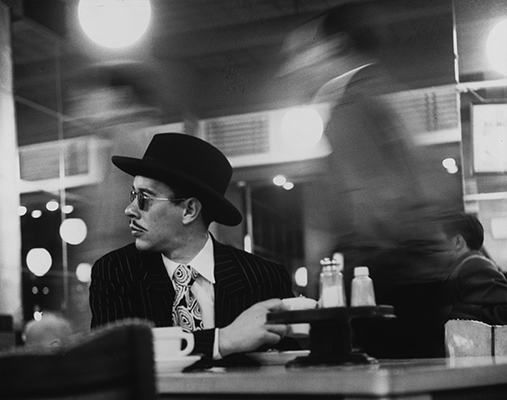
Ted Croner, New York, 1947
New York, 1947,, Ted Croner
Ted Croner's quotation, "They weren't pictures of people. They were pictures of the way I felt" made me jump. Emotionally it resonated with me as a very succinct way of saying what I've spent most this website talking about. Then it also made me think about how I found myself in a similar place fifty years later. I now live in a world where the American Dream is dominant, a consumer society is one I literally buy into it. Is my work any less authentic, just a re-run of an old 50s B-movie? I know I came to this form of expression in my own way, I wasn't seeking to copy, or pay homage, to any other photographer. It found me and gave me a voice. For me the "psychological gesture" is still as relevant today. The concerns of our lives have much in common with those New Yorkers two or more generations ago and I find it enervating to hear those echoes through the photography of that time.

On other note Roger Mayne was, welcomely but a little anomalously, included in the selection of works supporting the featured photographers. Apart from Young Meteors by Martin Harrison I can't think of an attempt on this side of the Atlantic to present photography in such a thematic way, a blend of the personal and the political. Perhaps it's time for another!
Update - a fascinating discussion, including Saul Leiter, emerged from the show which was captured as a video. In keeping with the theme of this post it's just as well heard as seen...

In addition here's a commentary on Louis Faurer's short film "Time Capsule"
http://www.nytimes.com/interactive/2010/04/16/arts/design/20100416-faurer-feature.html

20 Feb 2010

a black and white life

When I think of why I have devoted my work to black and white and not colour street photography, I must acknowledge the significance of my childhood spent in the flicker of black and white television. Absorbing those images not only gave me a view of the world outside, they gave me a way of interpreting it.
Black and white was drama: it told me stories, it made me laugh, it brought me to tears. Images played in my mind in black and white...I'm sure I dreamed in black and white too! The composition, framing and sequence of those stories beat a path into my subconscious.
For me colour was a wrapper, black and white was the real stuff, there when you dug your nails beneath the surface.
It's not that I haven't had dalliances outside my relationship with black and white.
I've used a cameraphone to experience the immediacy of the taken image, there in the palm of my hand. My technique transferred easily enough. However I found colour in itself wasn't a significant element, a red flag to my senses. What I did discover was that, no longer driven by the sunlight and shadow that saturates my black and white work, I was at liberty to explore flat grey days as well as interior public spaces.
The results for me didn't have the same engagement, soul even, as my black and white work, but stepping outside my usual way of working tapped into something different. Watch this space!