skip to main |
skip to sidebar
I've known the powerful images from Roger Mayne's Southam Street series for a long time and was honoured to be shown in his company at the survey of London Street Photography show a few years ago. Made at a time in London's history when my parents had arrived to be confronted by a culture of "No Blacks, No Dogs, No Irish" his pictures have a social context that give them an added edge for me. I had a real thrill when - oh what's that word? Oh yes - serendipitously, I came across the street sign while out walking beneath Trellick Tower, one of my London icons.
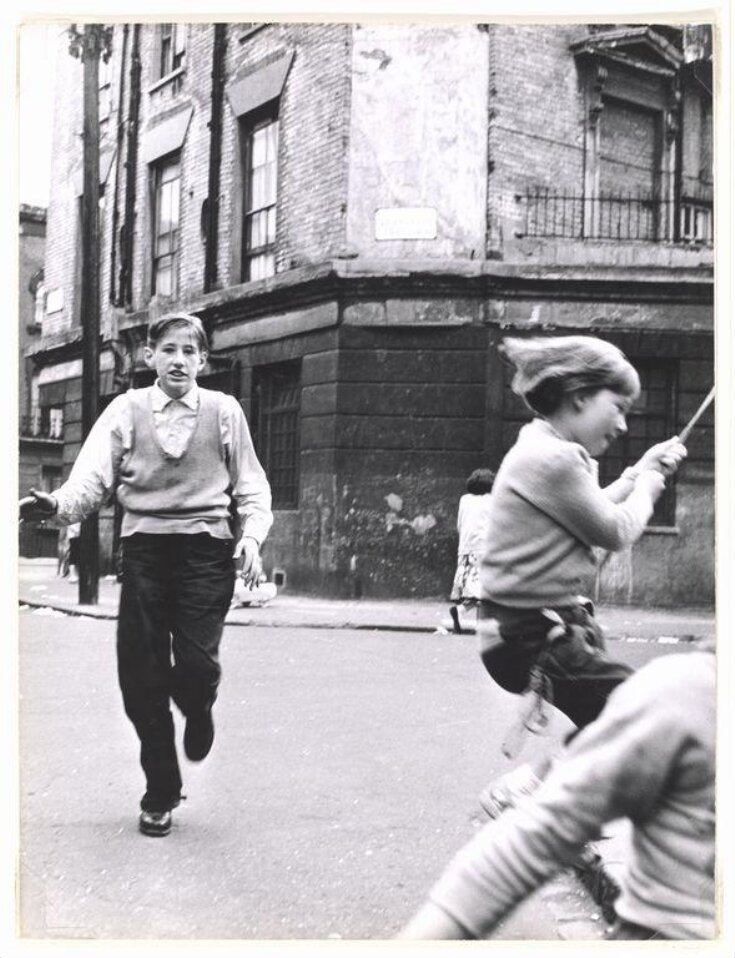
Southam Street, W10, Roger Mayne
I say sign because the fabric of the street has all but disappeared save two buildings looming like Warner Brothers film lot facades. Those terraces and sounds can now only be experienced in social documentaries of the era. I know I'm in danger of a nostalgia wallow - which could be said of my whole practice - but it's interesting to read Mayne's own words from 1959,
The reason for photographing poor streets is that I love them. Empty, the streets have their own kind of beauty, a kind of decaying splendor and always great atmosphere - whether romantic on a hazy winter day, or listless when the summer is hot; sometimes it is forbidding; or it may be warm and friendly on a sunny spring weekend when the street is swarming with children playing, or adults walking through or standing gossiping. I remember my excitement when I turned the corner into Southam Street, a street I have since returned to again and again.
It's hard not to avoid a comparison with Cartier-Bresson's privileged upbringing and subsequent love of photographing everyday life. Granted having the time and money to pursue this way of working for its own sake was - and arguably still is - a characteristic of street photography but should it have any bearing on judging its merit from our perspective?
I'd go back to my opening point that I take as much from the social context of street images as their own composition. You could say that's not untypical of any photography but for me it's particularly relevant to street which by its nature is a real time reflection of both the location of the photographed and the culture of the photographer.

So where are the Southam Streets of today? Well there are still plenty of poor streets but people are now documenting their own lives, spending as much time on written narrative as the image. Jim Mottram and Paul Sng are two notable examples and I'd also include James Hopkirk too.
The images speaks with originality and energy, giving insight into worlds too easily neglected. The photographer here is no longer bystander or daytripper but implicated and yes exposed by the work.
I was on that journey too once upon a time. Time bends.
Visually, with digital technology we’re actually coming closer to nature...If you look at anything natural under a microscope, it breaks down into fractals. And we are now looking at the world in fractals, through pixels, rather than a halftone, which is how we used to see images with print. Michael Stipe
I like the literal layers of these ideas, meanings uncovered as I read. I can see how digital brings us closer to nature in a literal sense. Does it leave room for mystery? Granted that's another word for ignorance or superstition or delusion and we're in the age of a second renaissance right?

I'm not about to rehash a digital versus analogue debate but having worked with both media I'm still drawn to the less than definitive qualities, the halftones, the half truths of film and print. They reflect my take on the world and as I've written about - at length - the ambiguities I enjoy.
It's September and both my film stock and opportunities to photograph diminish with the sun getting lower in the sky.

It's been a fascinating and frustrating season.
For good or ill we're now getting used to sunshine rather than rain in London. It's reflected in abundant street life especially as the city's tube experience flushes people above ground. My beat of Oxford Street, Piccadilly, Regents Street, Charing Cross Road and The Strand is still as busy as ever.
However New Europe has changed my patterns of when I'm active, now not as interested in the early morning/late evening moments of high-lit individuals silhouetted or squinting. I'm now as interested in the context of the street around those figures, the billboards and the buildings. It's already reflected in my pictures. They've lost that immediate impact (I missed my moment with Instagram) and they now require a little more time to reveal themselves, often not individually but collectively too.

I'm looking forward to discovering what pictures I actually made this summer. It's a nice time when everything is possible. It's mysterious and magical. I feel like a big kid. But then again. Maybe I am.
Well it's a little fraudulent to celebrate a tenth birthday - we had a three year hiatus along the way - but I'm proud to still be writing this blog and staying true to my original intention to use it to think about how and why.
My Ambiguous Project posts drew the most visitors. I've even managed to generate the odd comment along the way too. But I'm also conscious this has become very much an interior conversation and you, dear reader, must be complimented on indulging me.
Committing to writing regularly has been really rewarding, for me at least. It's helped me think about my work. Before then I thought that would obstruct my natural, intuitive style. But hey even Barcelona need a plan.
I've enjoyed joining the dots or hyperlinking, to use a technical term, my thoughts across the years. James Burke's Connections was perhaps my favourite TV show growing up (well along with The Goodies) and he's embraced the web in the same way. Spanning time and space. Not a bad way to describe my work if I think about it.

Coincidentally it's my own birthday around this time and I was delighted to be given a book by my family of the work of a London photographer I was shamefully ignorant of.
Bakerloo by Harry F Conway is a vital record of Londoners in their moments of passing through one of the West End's arterial tube lines. The images achieve a remarkable balance of both confrontation and compassion. I really admire this work not least because it's diametrically opposed to mine in many ways. He engages with the people in his pictures, forming momentary relationships that are complex and disarming. He's a visible presence going about his business in an constricted space in an open and transparent manner.
He puts it so well
...fleeting moments of pure humanity were shared, deep underground with complete strangers.
Where people see an monotonous system to merely transport them, I saw life in all its ridiculous beauty.
Amen.