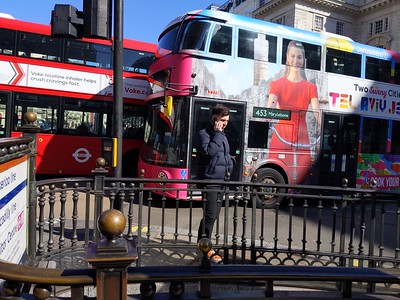
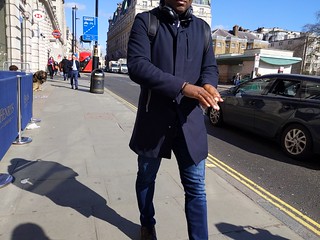
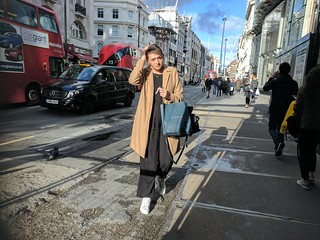
It seems timely to revisit a book I put together a few years ago called Distance Between Us. The images I chose illustrated my love of city life: the democracy of public space (the civilisation of civic space?). Moments where we share intimate proximity with strangers, creating serendipitous relationships on the wing.
At least that's what we used to.
The current coronavirus crisis has meant fundamental changes to our daily interactions with each other. A new phrase social distancing has entered the language. It's a fascinating and terrifying concept. It arguably strikes to the heart of our lives as citizens. We take freedoms of association and movement so easily far granted in what I'll call liberal democracies. Well this is a global crisis with lives of millions of people at risk (not forgetting the other one). Rome,Madrid and New York are already under states of emergency. Paris, Amsterdam, Dublin and Berlin limiting public gatherings. The very fabric of city life has disappeared overnight.
London waits.
Earlier this month I was at a strangely empty Photographers Gallery. Ten days later I wonder when I'll next be at an exhibition, performance or indeed any public gathering. I was there to see four nominees for the Deutsche Börse prize and admired the multidisciplinary approach of Mohamed Bourouissa including a piece of augmented reality.
Reserve army of the unemployed, Mohamed Bourouissa
The comparison with these shrouded figures to the images we're seeing daily of health workers clad in hazmat suits was powerful. Seeing them materialise in the gallery, silently observing our entitled behaviour, revealed the surrealism of our situation. It's a rude awakening.
I'm really glad I made it to the Dora Maar show at Tate Modern before it closes as, once again, my eyes were opened to another photographer who excelled at candid photography in the midst of social change.
Maar's story goes well beyond her trip to London in the 1930s so this work is very much a moment on her path to her better known life as a surrealist, encompassing photomontage, painting and poetry, but for me it was a fascinating example of little-known street photography - being outside the canon, obvs - that even in the few images in this show really gave me some small insight into her thoughts and motivations
The portraits in London are very much rooted in their environment. We see individual hardship in the shadow of the bricks and mortar of questionable financial probity. I hadn't seen an image of a pearly king in years and Maar's photographs really made me think of the historical representation and reality of English working class culture.
No dole - Work wanted - Lost all in business, Dora Maar, 1934
Pearly King collecting money for the Empire Day, Dora Maar, 1935
There's a mood about them, and her other photographs from the streets of France and Spain in the same period, that for me has more of an edge than the French humanist style of that time, feeling more affinity with the emerging American outsider. They reflect the social context of the times through the idiosyncratic, compassionate eyes of the photographer. Timeless in lots of ways.
The Trial of Tatsuo Suzuki sounds like a 19th century novel. The artist guilty of following an unacceptable moral code to create his work. Sounds familiar?
I first saw Suzuki's work about a year ago as part of Samuel Lintaro Hopf's On The Streetseries.
I find films of street photographers' working fascinating. Nick Turpin's In-Sight is a fine example. This one however had more of a punk aesthetic to it. Suzuki's modus operandi is closer to a 3 minute 3 chord than an improvisational jazz piece.
I must confess to empathising with his technique. No surprise there. However the controversy over his use in a Fuji ad campaign has been interesting for me as it's brought this particular style into public debate. He's seen as aggressive and rude.Others say it's very much on the tradition of street photography and it's seeing the making of the pictures that reveals actually what it takes to produce that work.
I take this to a point but the advent of digital must play a part too and can easily be characterised as spray and pray which can upset the purist. At one point in the On The Street film there's a discussion of SD cards and that 16GB is not enough as you can only take 500 pictures. That's 6 months' of images in my world.
I agree it's a masculine way of taking photographs. There's a sense of entitlement that it's OK to behave in this way. There are plenty of examples of arguably more just as creative work by women that aren't promoted at all.
Which, once again, leads me to think street is actually more about the photographer then the photographed. This is an argument that of course could be applied across all forms of photography but I think street comes closest because what can one ever really know about the people in the pictures?
When Cartier-Bresson goes to China, he shows that there are people in China, and that they are Chinese. Susan Sontag
So back to Suzuki who undercuts the theory with a very practical reason for his from the hip style. Looking through a a viewfinder doesn't work for him. He's left eye dominant. Furthermore he himself twists a cultural stereotype in his favour, "I'm just a stupid tourist". Hmm. Good line that.
The announcement by London's police force that it will use live facial recognition reminded my of a book I published a few years ago called Street View People View
The arguments against it are essentially the same (although the quality of the technology is still moot) but what's changed is the sense of threat to personal safety on the streets of London. It's well documented that London is, outside China, the most cctv'd (if that's a word) city in the world which I think has normalised (not a nice word) surveillance here. I'm certainly conscious of its absence when I visit other cities around Europe.
I'm also conscious that street photography is itself a form of surveillance. I've excused myself with the well worn argument that anyone - voluntarily - in a public space is open to being photographed. I must admit even writing this now makes me stop and think. I find myself thinking of clauses like some dodgy small print.
My pictures take months to produce so I don't share them randomly with my thousands (sorry, tens) of followers
They are on film so there is no exif data of specific time and place
People are in my pictures but the subject is the city
I acknowledge my work is becoming more anachronistic the longer I pursue it. The universal truths of earlier practitioners appear naive or repressive now. Street is still a valid form but it needs to reflect the present to work best, as it's always done. The New Europe project is my attempt to address that. It's given me greater motivation and purpose. It's also given me something else.
Well the summer 2019 results are in and I must admit to feeling underwhelmed. The patchy weather after the excesses of the spring didn't help but I never felt I got in the groove all summer. Kept missing the beat.
It's not surprising in some respects. I've tried to move away from that high contrast morning or evening sunlight raking across the West End silhouetting figures or exposing them to a brutal blinding beam. I've become more interested in the environments, social and emotional, around people. It's not about finding juxtapositions. More about taking a step back. Thinking a bit about context. It could be the news or something more personal. The consequence is a more deliberate, less pacey style. Snooker not slalom.
I don't think that's about losing the physical drive. It's an evolution of my style that really started after my break a few years ago that led to the New Europe project. It becomes evident when I look at my contact sheets. Now it's less obvious to see the ones to take on to print, there's fewer obvious "keepers" (forgive me). My rate of return is less but I'd like to think the images have greater depth, especially when seen in the company of others. I've tried to express it in the re-looking part of my 5 Acts approach.
Where does it leave me? I seem to say this every year but end up feeling like a football fan looking forward to the next season. It's not the despair, it's the hope that kills you. So the cliche goes. Roll on 2020.
I've been pursuing a style of photography now called street for a number of years. A south Londoner by birth I am pre-occupied with the West End and spend too much time there taking black and white pictures on film.
I nurture a hope that one day London will be recognised like Paris, New York and Tokyo as a great city of street photography but secretly like the fact that it is still the underdog.
For someone who enjoys the solitary practice of his work I am surprisingly talkative about it - although not at the same time.
Here's a collection of idle musings and distracting links. If anything catches your eye drop me a line at sean@waysofwalking.net