Showing posts with label books. Show all posts

12 Jan 2022

flatter to deceive

I first became aware of Jonas Bendiksen in a photography show at the PM Gallery when I remember being struck by an image from his Satellites project. This was a classic piece of Magnum photojournalism: humanist stories, documented against a backdrop of political and social turmoil. It was fascinating to discover that he had used the reputation of his persona and of Magnum to create a fictional documentary project, The Book of Veles, raising questions about authenticity, trust and the photography establishment.

It was a topic of interest for a number of us in my local photography group so I put together a short talk. In retrospect it's a companion to one I gave over a year ago on ethics.

There are lots of sources that describe the story but I found Ben Smith's interview very interesting and well worth a listen.


31 Dec 2021

the pandemic, a photographic history

I've been fascinated by the creative output the pandemic has produced, in particular - and unsurprisingly - through photography zines, books and exhibitions. I've referenced examples already but wanted to draw some themes from the ones I've picked up along the way.

It's also an opportunity to reflect on my own response, of course. We're at a significant point now in England. The national unity of the first wave of the pandemic feels a long time ago. We're approaching a new year better protected but with less confidence of getting back to normal than last December. There's a creeping realisation that how we collectively learn to live with the pandemic comes next.

The images and texts in these zines and books are already historic. However for me it's as much about the motivation behind creating them as the actual content itself. They represent ways of using the act of making images and of distributing them to help deal with the situations thrust upon people, in a highly engaged way. Perhaps it's the act of turning documentary practices onto individuals and communities more cross-sectional than stereotyped. The consequences are not only a record of our times but place image making, of and by ourselves, at the centre of that record.

The early days of lockdown initiated a number of "doorstep" projects and one I really like is Levy Lockdown Portraits by Ciara Leeming that she's now developed into a full participatory project with her local community sharing experiences through stories and diairies as well as photography.

Levy Lockdown Portraits zine cover

Using photographs to stimulate personal narratives is also a feature of Birmingham Lockdown Stories by Jaskirt Boora. Here we move from the doorstep into locations of peoples' choice, which is a wonderful way of creating trust and representations of worth.

Birmingham Lockdown Stories zine cover

Another zine with the mission to "move beyond the doorstep" was published this year. Still Life by WorkHorse Collective presents some innovative interprations of lockdown life with a mission to give a platform to people otherwise underpresented.

Werkhaus Still Lives zine cover

Taking control of representation is also a feature of My Camera My Therapy by Natalie Ball. Giving equal weight to the testimonials of photographers opposite their images in the zine is symbolic of their relationship with photography and the role it plays in their lives in lockdown.

My Camera My Therapy zine coverr

Paul Treacy produced another of his wonderful handmade books and it was great to see it picked up by the BBC. Pandemic Constitutional is a soulmate of Natalie Ball's work as a portrait of someone coming to terms with life with COVID. I can certainly relate to the structure of the work, found pictures taken on walks around a local neighbourhood, but Paul's phrase 'sustaining creativity' is particularly striking.

Pandemic Constitutional book cover

Two other personal collections of local life in the early months of the pandemic are Village Lockdown by Robert Law and Lockdown Fakenham by Keith Osborn. It's fascinating to cross-reference the images that could be interchangeable in places.
Village Lockdown zine cover

Lockdown Fakenham zine cover

At this point I have to mention two collections of London lockdown photography. The LIP Chronicles from the London Independent Photography group I'm a member of. Produced on newsprint, images from group members are arranged across a weekly timeline from the announcement of the what became the first lockdown in England, reflecting a range of creative responses. Even looking back at it now sparks memories.

LIP Chronicles cover

I must say the London in Lockdown collection, published by Hoxton Mini Press and introduced by Jilke Goldbach presents a tremendous range of work. Chris Dorley-Brown's early morning cityscapes I was familiar with and Jemima Yong's Field too. However for me the variety of images in Spencer Murphy's Our Bullet Lives Blossom As They Race Towards The Wall conveys the strangeness of those days perfectly.

London in Lockdown book cover

Continuing the theme of compilation, perhaps what will become the official record of events Hold Still published by the National Portrait Gallery is a survey of the nation taken from an open submission of portraits by people across the country. Raising money for Mind, it also generated a digital and an outdoor exhibition of the work across the country at the end of 2020. Looking at it now a year on it perhaps best captures what was characterised as the blitz spirit of that period.

Hold Still book cover

A 180 degree view of that are posed by three very personal works. A project I greatly admire and wrote about last year is good to reference here too. Amuleto by Francheska Melendez and Ben Roberts is a powerful synthesis of the pandemic in Spain and the Black Lives Matter movement. Eighteen months year on, the value of documenting that summer is so valuable as memories fade.
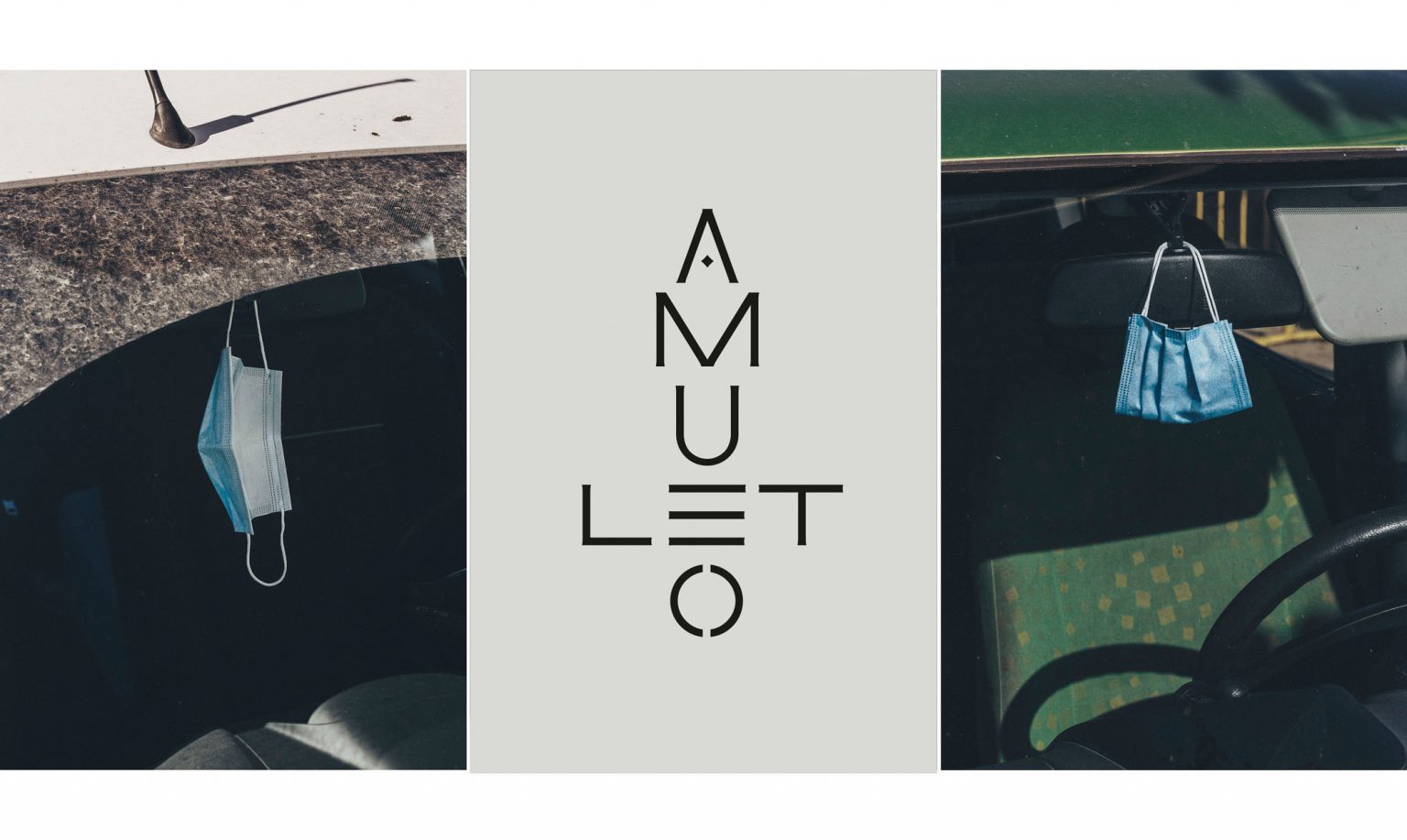
Amuleto book cover
Europe is also the setting of John Perivolaris's Pandemicon 2020-2021, an odyssey from Scotland to Italy and Greece, made all the more poignant by its dedication to the death of his mother from COVID.

Pandemicon 2020-2021 book cover

I've been intrigued by the idea of a box of prints and as an alternative to zines and books it was so good to see that approcah taken by Tristan Poyer and his work Masked: A Portrait of Amazon. His rationale is best read directly. I couldn't do it justice by paraphrasing it. For me it's the best testimony of this period I've seen.

Masked: A Portrait of Amazon cover

For completeness I'm going to add two of the first publications I found at the start of the pandemic and mentioned last year, Insiders and Limbo. Now in retrospect it's fascinating to see the work produced so early in the pandemic and that initial period of extreme isolation when many creative people found ways of expressing and supporting eachother.

Insiders zine cover

Limbo zine cover

I'd also like to mention a non-photographic work for the stimulation of its writing. When This Is All Over by The London Society is a range of essays about the possibilities and opportunities of post-pandemic life in London. It actually does have a some fine images and illustrations so I think I can sneak it in to this selection ;)

When This Is All Over cover

And finally - for now - I'd like to include a work that's just been crowdfunded so I don't have it just yet but with the title Photography through the Pandemic it's hard to resist.

When This Is All Over cover

I do sometimes feel I should just "move on" from the fixation with the creative consequences of the pandemic. When I see work like this it gives me faith to stay the course. 

A little longer.


25 Apr 2021

portraits in their place

"How does one inject oneself momentarily into someone's life and come away with something that resonates with some real aspect of the individual?"                           Dawoud Bey 

I've recently had the privilege of experiencing a new work by Dawoud Bey called Street Portraits. It's a collection of powerful photographs of African American individuals and couples largely from the streets of Brooklyn and Rochester made between 1989 and 1991. I use the word powerful carefully as he also describes his work as about 'not only the picture making part but there was very clearly the social part'. His portraits give a sense of agency, respect and yes power to the people photographed. I have a real sense of a collaboration, understanding and empathy between them and the photographer through their eyes, gestures and poses. 

Dawoud Bey Street Portraits book cover

For me this makes the images incredibly uplifting. It's more than the composition of the photographs and their reproduction, which are both magnificent, but they really speak to me if I can use such a contrived phrase. The titles of the images are at the back of the book so all the viewer has to work with on initial viewing is the pure photograph. Granted I still acknowledge the social and political context in a very simplistic way and having spent a short but significant part of my life in New York at this time there's a further, tenuous chord they strike.

Coincidentally I've been enjoying a series of online talks and discussions courtesy of Paul Halliday from a range of photographers including Bas Losekoot discussing his recent book Out of Place. I love the way the images have been brought literally off the page using different size pages to overlap each other and simulate the chaos and serendipity of the street. The insertion of improvised film scripts as a commentary on the photographs as stills is another neat angle.  

. Bas Losekoot Out of Place book cover

However for me the making of the images was a throwback to a way of working which I admire but find it harder to reconcile. Dropping into a society for a short period of time and finding ways to depict it, to give it meaning, can lend itself to decisions on subject and composition that make for interesting images but are open to question on representation of those cultures. It made me think of work by Philip-Lorca diCorcia and Alex Majoli which I enjoy but now find wanting...

I'm certainly not one to throw stones as it's a style of working I've been privileged to follow for a number of years The motivation behind my last book New Europe 2015-19 was to find a way of giving more social context to my photographs beyond the pure aesthetic of street life from different cities. I still have lots to do and I accept the limitations of this kind of photography. Street portraits used to be an oxymoron for me but Dawoud Bey's work is inspirational.


6 Apr 2020

only the lonely

I'm fundamentally challenged not just by the current restrictions on personal movement but by the impact of them on my very impulse for taking photographs. The irony of the phrase street photography comes home to me. The streets are nothing without people. Without people's faces.
Sadiq Kahn, London Mayor on TV
For succour I'm drawn to photo books. My guilty pleasuresI recently saw a picture by the photographer William Gedney posted on Twitter which lead me to a lovely collection of his work by Gilles Mora, Only The Lonely. Wilfully resisting or indeed neglecting to create any public profile for his work during his lifetime Gedney has only since his death achieved any recognition. His work has plenty of stylistic traits that interest me but I was drawn to his working practice, what Mora calls his "commitment to his art...born solely of a internal necessity"'
Myrtle Avenue, May 5, 1969, 4:45 pm by William Gedney
 Myrtle Avenue, May 5, 1969, 4:45 pm, William Gedney
His work is part of but also separate from the American 20th century documentary tradition. The words immersive and complicity are used to describe his technique and it's fascinating to see how he transposes that to his street work. One of Gedney's significant project was the documentation of life on Myrtle Avenue as he looked from his window in Brooklyn. One image that caught me eye is the only one in his archive titled with such specificity. It place not just himself but me as a viewer in that moment in time. I've always eschewed titles of any description yet this made me think again. It made me think of Chris Dorley-Brown's use of it in The Corners to root his images in an alternate reality. For me knowing the time the picture was taken doesn't define it but adds another layer of story telling, of possibility, of ambiguity. 
I'm intrigued. Why May 5? 4:45 in the afternoon? What happened on that day? At that time? I thought of the turmoil of that decade in America, powerfully portrayed by Paul Fusco's Robert F. Kennedy’s Funeral Train. I imagined Gedney listening to the radio and feeling impelled to record and reflect the moment. It'd be fascinating to see if anything is revealed in his writings. I don't think it's what I found.
I recognise this relationship of the ordinary to the extraordinary was my motivation for my New Europe project. It's also poignant that any photographs taken in 2020 will need no such checking. 
Everyone knows what started then.

15 Dec 2019

a cruel beauty

It's that time of year for me to enjoy the guilty pleasures of the photobooks I've picked up over the years. I say guilty as they do feel like an indulgence. Often bought on a whim, they still serve as an inspiration. I don't have a most wanted set and I don't really keep up with the latest releases, apart from the ubiquitous lists at this time of year. I just tend to let them find me. 
So it was with Krass Clement's Drum. 

The circumstances in which the photographs were taken have a romanticism underpinned by a sense of absence and loss. Arguably that's a reflection of a lot of cultures not just Irish but it's one I have to say I identify with. The world depicted by the images evokes memories of not just back home but here in London in the world my dad and his compatriots recreated.
I was taken aback when I found the work was made in 1991. It's space borrowing time from another dimension. Ireland again. I recall the disorientation of entering bars - and homes - like that. A certain theatricality to the arrangement of the room, the order of who sits where, the silence.
Family at home in Ireland

It's interesting how much the analysis I've read is about the photographer's empathy with the others in the bar. Each an outsider in their own way. A form of reflective photojournalism. Not judging. Observing a ritual.
 
Bearing witness. 

11 Apr 2019

looking at me?

In vain I'm trying to control my collecting of books, in particular ones which reflect city street life, especially London, so I try to choose ones with an original take. I'm pleased to say Nigel Shafran's The People on the Street is one of those.  
Like a lot of great ideas, it's very simple. It's becoming more common to encounter homeless people on the street. For me they have no choice in the matter so I don't purposely take pictures with them as a subject, however in its own way that's ignoring their existence. There's already an argument that self censorship in this way will mean future generations won't have a record of children on the street so I like seeing projects where they can document their own lives. Following similar logic Shafran empowers homeless people by giving them a camera to take pictures not of themselves but of himself.
People on the street book cover
The resulting book is a powerful commentary on a societal responsibility but also, if it's not too indulgent, on documentary photography itself. There's an important debate about the best photographic practice in documenting people's lives all around the world which doesn't simply objectify them or worse. We're not now living in a time where Life or National Geographic ran photo stories of exotic other worlds, reinforcing stereotypes of difference, and yet that form of representation is hard to shake off. Homeless and, more broadly, other disadvantaged people occupy a similar status of otherness in this country today whether that's a kind of "by the grace of god" or "it's their own fault" attitude. It's worth mentioning two other current UK photography projects that directly address this, J A Mortram's Small Town Inertia and Paul Sng's Invisible Britain. Not worthy or patronising photographs. Work that's part of a broader context of social engagement and change. Inspirational stuff.

10 Apr 2018

dear, damned. deceptive city

I'm always on the lookout for photography books about cities - London in particular of courseso I was really pleased to discover both a wonderful book and a photographer I'd known nothing about. It affirms my faith in the photobook as a 
Londýn 60. let / Sixties London by Miloň Novotný affirms my faith in the photobook as not just a nostalgic trip to the past or an arms length glimpse of a  another world but as much a reflection on our own place and times. I found myself visualising the exact spots where Novotný would have stood in Picaddilly Circus, Tottenham Court Road or Cornhill. Reminds me of the Street Museum idea that I still would love to do something with. Oh dear. Too late.
Milan Novotny's londyn 60. let review 
For me there's a connection to the work of Markéta Luskačová and Sergio Larraín which makes it all he more interesting, a kind of cross referencing of people and place with the eyes of a outsider.
Social class as explicitly referenced in the photographs of the City and the East End is a common denominator but so is the less stratified world of the West End. It resonates with me as I've always enjoyed the social mix drawn by the shops, businesses and tourist attractions there. The City has some of that and arguably the East End is on its way. Maybe it's the South Londoner in me that's behind this so I love to see how photographers from different backgrounds approach the city.
I couldn't resist titling this post with a phrase A.G. Hughes uses in his essay accompanying Novotný's photographs. Dear, damned, deceptive city. It's a dramatic phrase, in a way at odds with the images at first glance. Yet thinking of the times these pictures were made London was undergoing enormous social and physical change, transforming the city in similar ways to our present time. I can't see it appearing as an advertising strap line on the Tube but I feel it around me. 
 Dear, damned, deceptive city.

3 Mar 2018

street philosophy

I see a new book on Garry Winogrand is about to be launched. Written by Geoff Dyer whose book The Ongoing Moment I really enjoyed for his lateral take on the history of photography I'm sure it'll be a good read.
Garry Winogrand is such a go-to reference for what I'll call classic - and others may call old fashioned - street photography that it's curious I honestly was not aware of his work when I started practising. Apologies if that's disingenuous. I can see my work reads like a Winogrand-lite tribute act. 
Oxford Street photograph
But my inspiration I recall was through the documentary work of Don McCullin's Homecoming and W. Eugene Smith's Minamata. Back in the day what became known as street wasn't publicly available, in the UK at least. Yes it feels a little sepia toned even writing this. Let me fetch more ink for my quill...
At that time I actually made this type of work, in style and in conscience. Now, in retrospect, it's one of those what-if questions about life (in)decisions. I know I struggled with the anthropological/us & them approach to documentary work which I why I admired for example Jim Goldberg's Rich and Poor project that found a way to break down the viewer/photographer/subject relationship into something fresh. 
I have to accept my own style can easily be seen as making no challenge to those relationships. There's no collaboration between myself and what I photograph. They are still subjects. I seek no deeper insight into their condition. My only only nod to objectivity is not to caption the picture. And yet it's that very ambiguity that I find fascinating and enduring. Geoff Dyer comments in his book on a particular Winogrand photograph from the late 50s/early 60s
In colour, people seem necessarily to be walking into the future (when the overwhelming bulk of photography will be colour); in black-and-white, they are emerging from the past (when black-and-white was considered the only medium for serious photography).
It's a question I've thought with regard to my own work. Is it simply a nostalgia trip, a re-tread of old tropes that were new and radical back in the day but now really saying nothing new? I've fallen back on on jazz, one of my favourite comparisons, and the way that standard compositions can be endlessly re-interpreted. I guess the challenge for me is to stay Miles Davis and not Kenny G...
New York City 1987 photograph
Tokyo 2017 photograph
I'm now looking back at my work from thirty years ago and, yes, those people are still emerging from the past...as they are from last year too. Does that continuity, that plus ça change, say anything worthwhile? I hesitate to use the phrase human condition as for me it's rooted in that black and white world of Life and Picture Post photography that in a contrary way reinforced social stereotypes while ostensibly celebrating them. But hey are we any more sophisticated now? 
Perhaps I just need to appreciate these pictures for what they are. Tiny breadcrumbs of my life. Watch out. Sounds like a book title...


12 Jan 2018

tale of two cities

I have a confession to make. I cannot resist books about London. Not the "1001 things you didn't know" sort - although I'd make an exception for Ed Gilnert's The London Compendium and, er, Nicholas Barton's The Lost Rivers of London. Anyway you get the idea. I've written about fiction and historical novels as sources of inspiration but two books I've recently read with more of a documentary angle really made me reflect on the present day London.
book covers
I've been an admirer of Iain Sinclair's writing about London since I read Lights Out for the Territory. His leaps of imagination, making links across time and space, really attracted me. In fact the subtitle of that book was 9 Excursions in the Secret History of London (I know, I know, it's just another exception) and he introduced me to the wonderful word palimpsest as applied to the streets of London still bearing traces of their existence as thoroughfares for Romans or Victorians. I really connected to this vision of London as both organic and mythical: a world simultaneously virtual and real as brought to life by Streetmuseum. 
Sinclair's novel The Last London has a different tone. The layers of history he's mined are now exhausted as London's latest incarnation is populated by people living "above the city, floating on their devices" in a perpetual present tense, in a virtual world disconnected from any historic, cultural or social roots. This is a London he doesn't know how to interpret any more. His reference points carelessly uprooted, appropriated and repackaged to feed the global market.
However he also is disturbed by another consequence and, unexpectedly for me, it linked his and Ben Judah's This is London. Where Sinclair observes the evidence of immigrants sleeping rough at the side of a canal yards from an artisan cafe, Judah is sleeping alongside them in the underpass at Hyde Park Corner listening to the footsteps of the new denizens of the city in a nightmare soundscape. However he shares Sinclair's troubles that he also doesn't understand what London has become.
It's a powerful book. Judah facilitates the stories of people not in the gentle style of Craig Taylor's Londoners but in a sequence of personal testimonies you might hear from voices on a BBC World Service documentary but here in London. Today. At the Museum of London last year I heard Judah passionately narrate his last chapter about Hajji an imam who washes the bodies of the dead before burial. "There are angels hovering over Leyton". I've just checked when he spoke. It was the day before Grenfell. What's that about palimpsests again?
Perhaps I had some intuition about the relationship of the two books. Most likely it was simply two sides of the same coin but after reading them I felt something more fundamental. 2017 was a defining year for London in the way 2016 was for the country The city has always had the capacity to contain a multitude of narratives but the fear that we are all becoming party to a more institutionalised version, a place closer to Beszél and Ul Qoma, leaves me uneasy.
Not so uneasy as to leave however. I'm not going anywhere just yet.


6 Nov 2017

tokyo drift

One of the many highlights of my last visit to Tokyo were trips to the wonderful photo bookstores of the city. It's not that I needed another stimulus to photograph but the culture those places represent is powerful. I felt the classic crisis of choice where there was just so much inspirational work I could have walked away with nothing except a, rather wonderful, headache. However I did manage to select two beautiful books by Naohiro Harada and Michio Yamauchi.
cover of Naohiro Harada's Drifting
I am immediately taken by the images of Harada's book Drifting. High contrast, displaced snatches of figures. Elusive. The sequencing of images resonates with the push-pull rhythm of city streets.
"All these people are drifting, on the surface of the silent jet black film, my body drifts inside them; and their bodies keep drifting too, inside me."
This sense of flow is something I've spoken about. It has unavoidable echoes with Zen in the Art of Archery which has its advocates, and detractors too I admit. Nevertheless it's fascinating to see the realisation of a sensation like this into a body of work that can leap off the page at me. Subarashī!
cover of Michio Yamauchi's Tokyo Up Close
My love of candid, black and white photography from the street is well met by Michio Yamauchi's Tokyo Up Close. It's a great collection of images, very much what is says on the tin but none the worse for that. 
"The photographs I take are all photographs; even so, I believe that 99% of them are pretty much equivalent to garbage. It's the remaining 1% that intrigues me and causes me to wonder at my reaction to those instances of reality. And then another person, looking at photographs I've taken in response to my arbitrary reactions, reacts too. Other people are able to feel my reactions - that's even more intriguing."
Again another quote and another connection to reflections I've made. The subjectivity of meaning, and the sharing of those interpretations, were my motivations to create the Ambiguous Book Project!
Photography in book form is regarded as an art form in itself and I'm really privileged to have two such examples in my collection. Time to think about some new ideas...


5 May 2013

London joins the Photobook Club

I recently had a great opportunity to share my love of photobooks with some like-minded souls at the first Photobook Club London event.
I'd discovered the club earlier this year and was particularly taken by a project that the force behind it, Matt Johnston, had initiated based on a book that had really fired my imagination back in my New York days, Invisible City by Ken Schles. Matt and Ken created a "digital resource" effectively enhancing the experience of the original work with interviews and notes. A real treasure.

OK back to the event. The Photobook Club idea has spread far and wide around the world. Formats range from Bring Your Own Book, sharing its personal significance, or more formally discussing a "book of the month". I'm pleased to report the first London meet-up took neither course.
Hosted at the marvellous Ti Pi Tin space in East London we were able to spend time perusing the photobooks on display and pick one, or more, off the shelf that took our fancy to discuss with everyone else. The choice is intriguingly diverse. Japanese miniatures bound by silken threads, idiosyncratic self-published pamphlets, heavyweight tomes from the major publishers all vied for my attention. 
Between chatting to the other attendees my attention was caught by a navy blue cloth-bound book. The subtly embossed cover listed names, like a roll call of lost souls. Inside I found a collection of portraits, consciously stylish, but for me at least with a more personal, deeper connection. The mood had an elegiac quality, informed both by the title, Nothing Lasts Forever, and the subject itself, the transition from youth to something, somewhere else. I had no knowledge of the photographer, Tyler Leboneor of the book beforehand so when I came to discuss it with the group it was wonderful that someone could tell me yes it was a fashion photographer's study of his friends and, in addition, they were from South London, place of my roots. OK not so challenging but a great way of broadening my usual diet of monochrome urban grit. Not so good for digestion.
Anyway around the table we became gradually more confident to express and discuss our thoughts. I'd like to think it was very much in the spirit of the Photobook Club idea. Everyone had something to contribute. Everyone came away a little richer. Can't wait for the next one.

30 Dec 2012

we're all Londoners now

Editing my work for the new website reminded me of the excitement of finding something new in pictures that I'd thought had nothing more to offer. It got me thinking of taking that process up again in book form which, as after publishing Ambiguous, I'd been taking a break from. Indeed, as well as selecting images, the process of sequencing, of shuffling, pairing and juxtaposing, was one I've really enjoyed and found to be another rewarding way of looking at my photographs. 
My initial idea is to develop the Londoners theme. Seems obvious in retrospect but I suppose I've always considered the character of the city itself as significant an element in my images as the people themselves. Focusing, literally, onto individuals is a challenge to me. It's not "my style". However for me making books has become an opportunity to question just that. I love the constraint of working to a particular format, to a particular image size and shape. I'm attracted to print on demand services as I can experiment with these ideas at low cost. Consequently I choose another economy style, a little bigger than The Distance Between Us. As with that book it makes me think hard about one of my absolute articles of faith FULL FRAME, NO CROPPING. However whether by accident or by design - hey, another one of my catchphrases - this decision becomes a lot easier as the narrow, portrait format lends itself very well to the Londoners idea. The consequent crop gives the figures centre stage. Significantly some of the minor players, those with bit parts in the original, now come to the fore thanks to the indiscriminate scythe of the crop tool.
Initially the book takes on a claustrophobic mood. Images full bleed over the edge of the page, facing each other on left and right pages. I cannot seem to avoid the influence - although I'm certainly not in the company - of two of my favourite books, Invisible City by Ken Schles and Michael Ackerman's Fiction.
However I realise that the subject of the book is now the city itself, not the individuals as I'd proposed.  As a statement of intent I re-name the book Londoner. I step the images away from the page edge. I give them each their own page of white space opposite. Two simple acts but transformative. The pace of the book slows. The energy of the images is not diluted but accentuated. The individual figures become just that, no longer competitors in an Olympian 100 metre dash, but characters in a marathon performance of Shakespearian comedies and tragedies. 
link to Londoner book

21 Sept 2012

decisive moments

The decisive moment is a phrase I've often questioned. It's a neat strapline serving to communicate the essence of street photography. It leaves no doubt what constitutes a great, or even good, street photograph.
In my own work I've played with the notion of decisive. In my world the precise moment is left to the trinity of my partners Fate, Chance and Serendipity. The results can be interpreted as lucky shots. I'd argue that my approach takes just as much presence of mind, channelling the spirit of John McEnroe as well as Eugen Herrigel.
This debate has for me been refreshed by two recent, well in the last year but time for me is a little elastic, events.
I'm not a great follower of new cameras but I couldn't ignore the buzz around a new Nikon. Let me hand over to the experts... 
Smart Photo Selector (SPS) captures the perfect moment in any scene; shooting 20 full-resolution images in the time it takes you to snap a photo: you just press the shutter once and, utilising the pre and post capture technology, the camera starts to take the pictures before you’ve even fully depressed the button. Your ‘best’ five shots are saved based on facial expression, composition and focus and the ‘perfect’ shot is presented to you. Never again will you miss the very second a dog catches a ball or the joy on your child’s face while they are on a swing. 
Well fancy that. Not one but 5 decisive moments. Now I'm not so old as not to know about motor drives but the concept of "pre-capture" is fascinating. Are we now about to see bodies of work of pre-decisive moments, full of nearly men and wannabe women?
Well guess what. With no suggestion that any pre-capture technology was employed a new - OK six month old - book by Paul Graham reveals sets of sequential pictures from a fixed point of view, a cascade of decisive moments each as valid as the one before...or the one after.
link to Rockefeller Center, 23rd April 2010, Paul Graham
Rockefeller Center, 23rd April 2010, Paul Graham  
The Present neatly denounces the first article of faith of street photography by referencing the stock elements of the genre: New York City sidewalks, late afternoon sunlight, office workers and panhandlers, visual puns and ironic juxtaposition. Each served up and hit to all corners of the court. It's a tour de force but executed so clinically it's more an exhibition match than championship final. Decisive moments are ten a penny here, but nonetheless still precious, their value quality not quantity.
For me the spirit of this particular deconstruction of street photography is one of renewal. It describes a way forward to a place where street photography can still be fresh, relevant and of today. Not just a homage to a golden age nor replacing the bow with a Tommy gun to make damn sure you get your shots.
This is a place where moments are still sought and celebrated but it's not 30s Paris or 60s New York. Any decision of our times is a best guess.
It's still some way in the distance for me but I think I'm on the road at least!

7 Apr 2012

eyes on the street

I try and mix my reading between fact and fiction. Much like my life really. Two books I've recently enjoyed, Ground Control by Anna Minton and The Man of the Crowd by Edgar Allan Poe, have given me some great insight into my street photography.

I've always been conscious, and used to my advantage, the aversion of most people on the street to actively looking around. This self absorption is a natural defence mechanism to unwanted eye contact. However the act of looking can be interpreted as an act of social responsibility. Drawing on Jane Jacobs's portrait of New York neighbourhoods of the fifties, their rhythms of daily life observed by a cast of characters from a Helen Levitt street scene, Minton contrasts that particular form of natural surveillance, mutually acknowledged by strangers for the common good, with our modern experience. 

Granted it's a jump, perhaps not so great, to the anonymous, unsyncopated churn of London's west end of today but what struck me was her description of this activity as the "eyes on the street". Who now occupies this role? Who is sensitive to the hour of the day, to the random acts of strangers?

link to image

This notion of eyes on the street, of a self-anointed guardian angel, sprang to life when I then read Poe's short story. In The Man of the Crowd I'm dragged through the streets of Victorian London in pursuit of an anonymous figure, an odd man out, a consequence of the author's surreptitious survey of the passing scene.

The wild effects of the light enchained me to an examination of individual faces; and although the rapidity with which the world of light flitted before the window prevented me from casting more than a glance upon each visage, still it seemed that, in my then peculiar mental state, I could frequently read, even in that brief interval of a glance, the history of long years.
Published in 1840, neatly coinciding with the pioneering work of Fox Talbot, Poe foreshadows a street photography routine, one in fact taken up superbly by Sophie Calle's Suite Vénitienne.
On reflection these two sources give me a real sense of the significance of street photographers today, just in the simple act of doing what we do: stopping, looking, stopping, following. Minding other people's busi-ness.

26 Oct 2011

street view people view

I'm been struck by the parallel debates about privacy on the internet and on the street. Central to both arenas is the image of the individual, the rights of its ownership and distribution.
The rise in popularity of street photography has brought fresh attention to the practice of taking pictures of people without explicit permission. On the web the ongoing debate over privacy is regularly fuelled by the latest Facebook feature or expansion of Google Street View.
There is already technological convergence between the street and the screen. Face recognition to optimise the identification of criminals by cctv is also marketed more benignly to find friends in party photos posted online.

This debate is not new. The tension between individual and state as played out on the street has been reflected in literature, often in a dystopic future. From George Orwell's 1984 to Will Self's Book of Dave a vision of Londoners is portrayed living with the consequences of the gradual relinquishing of our privacy.
My most recent collection of photographs, Between the City and the City, explores an idea of parallel experience, how we each live together alone in the city, our faces more like façades. It now forms the backdrop for a new book, Street View People View, that develops the relationship of our faces and the ownership of their image.
link to People View Street View book
The title of the book has been on my mind for a while. It seemed, for me at least, a logical next step in the enhancement of the digital documentation of public spaces to that of the people within those spaces. We can already identify our friends' physical location courtesy of mobile phone apps. Enhancing that visually would be neat wouldn't it? Imagine scanning a crowd with an augmented reality app that highlights those individuals. Cool.The anonymous crowd, familiar to the street photographer as the human zoo, now becomes a photo gallery of individuals, instantly profiled and packaged. Science or fiction?
As with my earlier books, Portrait of a Street Photographer and The Distance Between Us, I've thought about how those particularly wonderful characteristics of a book could be used to express these ideas. Consequently I've found myself breaking some of my own taboos.
I was looking for a way of simply illustrating the book's title. One design idea I tried was alternating the sequence of images with upside down cropped versions of each picture, including two separate front covers. The not-so-simple idea was the book could be experienced as a set of "street views" in landscape format and "people views" in portrait format. I liked the intention but the execution was a little laboured. I did however, whisper this, like the cropping so I kept that and tried another approach.
I've shied away from captioning my images in the past but I wanted to refer to the ideas that lay behind the book. Including quotes from press releases, novels and news stories satisfied that. Granted not a particularly original idea - I think Michael Lesy's Wisconsin Death Trip was the first time I saw this technique.
I considered really ramming the idea home with speech-bubbles above each figure's head with sample personal details. However I wanted to retain the feel of the images as pure street photographs and not interfere with them directly. This literal sub-text is then there as something for the viewer to consider as a separate but related element, more like a collage.
Finally I chose not to include any rationale in the book itself, This is exclusive to this site!
Street View People View felt like an opportunity to reflect on my own work, and the city I live in, and to consider street photography in a broader context in which it may be practised in the near future, coming to a corner near you soon...


19 Aug 2011

between the city and the city

I'm pleased to share some new pictures with you. Despite my dalliances with colour and video it's very much a case of ploughing my lonely furrow in terms of technique. What I have done is also develop my fascination in ideas of the city as expressed in novels.
At the heart of the The City and the City by China Miéville is a magnificent leap of imagination. Taking a concept of how we relate to one another as strangers, sharing the intimacy of the street while constructing our own personal narrative, accounting for but not recognising others, the author creates a world where that's been institutionalised. 
Two cities exist but not in the way of Belfast, Beirut or Berlin, topographically divided by walls or no go areas. While these two cities simultaneously occupy the same streets, each set of citizens exclusively experience their own, with the threat of instant prosecution if they ever let the veil fall. 
The beauty of the novel is that there are no passages that neatly describe this state. It's subtly revealed, incidental to the main narrative. 
There are places not crosshatched but where Beszél is interrupted by a thin part of Ul Qoma. As kids we would assiduously unsee Ul Qoma, as our parents and teachers had relentlessly trained us (the ostentation with which we and our Ul Qoman contemporaries used to unnotice each other when we were grosstopically close was impressive).
The symbolism of such a city is far-reaching and raises political, social and ethnic issues. Personally I find inspiration for my own work. Mirroring the distance between us which recognised those moments when we are in momentary accord with one another, The City and the City is a place when we are quite literally in our own worlds, unseeing and unnoticing one another.
link to new photographs
It's hard for me not to relate these ideas to the recent disturbances on the streets of London where, arguably, those rules of engagement were literally torn up. There's enough analysis on the events themselves. Worthy of reference is Peter Marshall in particular. 
So, without intending to use them as material for an abstract intellectual analysis, my response is framed by my obsession about the streets and our relationship with them. 
For me the fine line between two or more Londons that exist at once in our own non-fiction world was disturbingly exposed. I practise photography on the streets because, as I've written in my recipe for street photography, I love the mix of people that share them. As a street photographer I have to transgress that conditioned state of unseeing, ironically creating its own conflicts although safely contained within my own mind, occupying a place between. 
My enduring experience of the riots was witnessing the fragility of those boundaries and recognising the very nature of the city is temporary. As another well known thinker phrased it, all that is solid melts into air.