skip to main |
skip to sidebar
I've been toying with new ways of working. Film will always have a special place and it's been wonderful to fall back in love with it again over the last year.
Singular focus and dedication to a cause, the 10,000 hours story, has its merits. That perfect shot is just around the corner, it has to be...surely? I confess at the same time it becomes a comfort zone. I've taken the plunge into digital, although just through a camera phone, dallied with video and so next up is the wild west of 360.
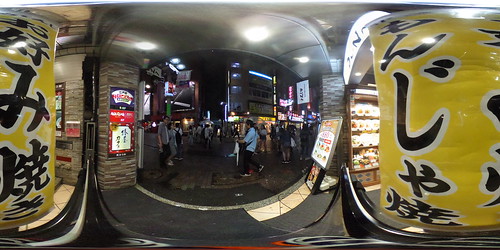
A trip to Tokyo seemed the perfect opportunity. A collision of ancient and modern, Blade Runner in a petri dish.
How did it go? Well it's certainly out of my comfort zone! Pretty much every maxim I follow is quite literally turned upside down.
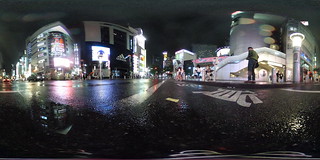
Is it street? Absolutely. As you immersive yourself in the image you are in the moment as well as outside it. A participant and an observer. Part of a bigger story.
That's life. That's street.
Not my typical topic but I must mention the artist Mat Collishaw’s current installation using virtual reality (VR) with the subject of the world’s first exhibition of photography held by William Henry Fox Talbot in Birmingham in 1839.
At first sight you see a white washed room empty apart from a set of tables and cabinets also painted white. Donning a VR headset transforms the space into a detailed recreation of the room at the time of the exhibition.
This is itself a compelling idea but I admire the attention to other facets of the experience both sensory and historical that enrich it. Mice scurry across the floor, smells and heat from a fire prickle your face. Moths get too close to the candle flames. You can hold a glass photographic plate. From outside the window the sounds of Chartists demonstrating against new technology taking away people’s jobs echo through space and time. Other 21st century visitors appear in your field of view as ghostly shapes.
Thresholds by Mat Collishaw from Mat Collishaw Studio on Vimeo.
My fascination is in the way Collishaw uses
- new technology to tell a story in way that enriches it without it becoming a product demonstration
- VR in particular as today’s magical way of representing reality
- the original uncertainty around what photography was and who was it for as a counterpoint to the current ubiquity of images
- photography as a harbinger of social disruption (last but not least)
As a practitioner of photography very much rooted in the 20the century it prompts me to revisit my thoughts on modernising street photography. Can these technologies add another dimension to my ways of working? Not only in creation but in production, display and distribution?
Interesting times!