Showing posts with label stories. Show all posts

12 Jun 2020

eye opening

There are far more significant impacts on peoples' lives in lockdown but, for the privileged, access to collective experiences of any description are one that people miss. The last exhibition I saw feels in retrospect both prophetic in its content and historic as an example of a world since turned upside down.
Our experience is now like a lot of things screen based so I was impressed by the approach Four Corners took to switching their Another Eye exhibition to an online version.
Another Eye exhibition
Another Eye exhibition catalogue cover
A survey of women photographers displaced from Germany and Austria in an era of anti-semitism and political persecution to make new lives in Britain in the 1930s caught my attention as another reflection of our times. The perspectives  and subsequent influence of these women was fascinating to discover. I confess the only one I was familiar with was Dorothy Bohm who I had the fortune to hear speak a couple of years ago at Street London. 
Another Eye exhibition - social documentary
Illustration from Another Eye
The significance of Gerti Deutsch, Elisabeth Chat and Edith Tudor-Hart on the development of Picture Post was my highlight of the show. I love finding copies of this magazine which is such a rich resource of social history and discovering their work was another wake up to the (un)recognition of women in the history of photography.
This work are great examples of the humanist tradition of photography that publications such as Picture Post and Life championed. However nowadays it's a form that is rightly challenged. The rights of people to control the representation of their lives is paramount to help empower them and dismantle stereotypes. However for me the work in this exhibition has an integrity that does not dilute its effectiveness. It's a salient illustration of what an outsider can do using their own experiences of alienation. 
Empathy. An important word for our times.

14 Nov 2019

southam street blues

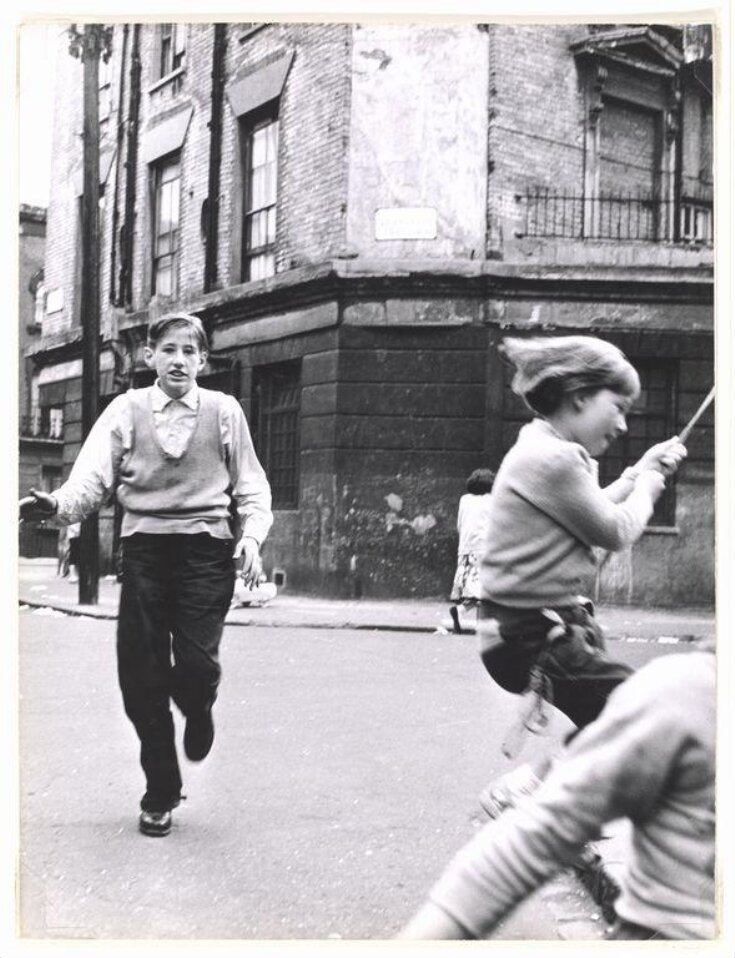
I've known the powerful images from Roger Mayne's Southam Street series for a long time and was honoured to be shown in his company at the survey of London Street Photography show a few years ago. Made at a time in London's history when my parents had arrived to be confronted by a culture of "No Blacks, No Dogs, No Irish" his pictures have a social context that give them an added edge for me. I had a real thrill when - oh what's that word? Oh yes - serendipitously, I came across the street sign while out walking beneath Trellick Tower, one of my London icons.
London street image
Southam Street, W10, Roger Mayne
I say sign because the fabric of the street has all but disappeared save two buildings looming like Warner Brothers film lot facades. Those terraces and sounds can now only be experienced in social documentaries of the era. I know I'm in danger of a nostalgia wallow - which could be said of my whole practice -  but it's interesting to read Mayne's own words from 1959,
The reason for photographing poor streets is that I love them. Empty, the streets have their own kind of beauty, a kind of decaying splendor and always great atmosphere - whether romantic on a hazy winter day, or listless when the summer is hot; sometimes it is forbidding; or it may be warm and friendly on a sunny spring weekend when the street is swarming with children playing, or adults walking through or standing gossiping. I remember my excitement when I turned the corner into Southam Street, a street I have since returned to again and again. 
It's hard not to avoid a comparison with Cartier-Bresson's privileged upbringing and subsequent love of photographing everyday life. Granted having the time and money to pursue this way of working for its own sake was - and arguably still is - a characteristic of street photography but should it have any bearing on judging its merit from our perspective? 
I'd go back to my opening point that I take as much from the social context of street images as their own composition. You could say that's not untypical of any photography but for me it's particularly relevant to street which by its nature is a real time reflection of both the location of the photographed and the culture of the photographer.
London street image
So where are the Southam Streets of today? Well there are still plenty of poor streets but people are now documenting their own lives, spending as much time on written narrative as the image. Jim Mottram and Paul Sng are two notable examples and I'd also include James Hopkirk too. 
The images speaks with originality and energy, giving insight into worlds too easily neglected. The photographer here is no longer bystander or daytripper but implicated and yes exposed by the work.
I was on that journey too once upon a time. Time bends.


25 Aug 2019

happy returns

Well it's a little fraudulent to celebrate a tenth birthday  - we had a three year hiatus along the way - but I'm proud to still be writing this blog and staying true to my original intention to use it to think about how and why.
My Ambiguous Project posts drew the most visitors. I've even managed to generate the odd comment along the way too. But I'm also conscious this has become very much an interior conversation and you, dear reader, must be complimented on indulging me. 
Committing to writing regularly has been really rewarding, for me at least. It's helped me think about my work. Before then I thought that would obstruct my natural, intuitive style. But hey even Barcelona need a plan. 
I've enjoyed joining the dots or hyperlinking, to use a technical term, my thoughts across the years. James Burke's Connections was perhaps my favourite TV show growing up (well along with The Goodies) and he's embraced the web in the same way. Spanning time and space. Not a bad way to describe my work if I think about it. 
Bakerloo Book Cover
Coincidentally it's my own birthday around this time and I was delighted to be given a book by my family of the work of a London photographer I was shamefully ignorant of. 
Bakerloo by Harry F Conway is a vital record of Londoners in their moments of passing through one of the West End's arterial tube lines. The images achieve a remarkable balance of both confrontation and compassion. I really admire this work not least because it's diametrically opposed to mine in many ways. He engages with the people in his pictures, forming momentary relationships that are complex and disarming. He's a visible presence going about his business in an constricted space in an open and transparent manner.
He puts it so well
...fleeting moments of pure humanity were shared, deep underground with complete strangers. 
Where people see an monotonous system to merely transport them, I saw life in all its ridiculous beauty.
Amen.


28 Jul 2019

speck on a clover

Today could be hottest day ever as 39C heat roasts Britain read the headline. In my contortions over the climate emergency versus my photography, he(art) won and I found myself on the street subsumed into Manhattan-style humidity. However by lunchtime clouds were creeping over Oxford Circus with the promise of lifting later so I sought solace in the company of Trent Parke's pictures at the Magnum Print Room. It was my second contact with Magnum in recent weeks. I attended their symposium last month where interestingly enough the best part was the keynote by Mark Sealy on western photographic practice. More of that in a future post. 
Trent Parke show image
I was first made aware by Nick Turpin of Trent Parke's The Camera is God at a street photography symposium a couple of years ago. He cited it as an innovative development on the tradition of the genre and I must agree having seen them. The images are fascinating in themselves but I also love they are made by what are now called analogue practices in taking them on film and printing them in the darkroom.However this project is certainly not rooted in nostalgia .The literally indiscriminate practice of CCTV cameras in cities shaped Parke's approach taking 30 second bursts without specifically framing anyone. As if that would ever catch on.
The way the images are displayed form a chorus of fragmented fractured faces, discernible as human but anonymised into atoms of light and dark. However there is still just enough detail in each image to project possibilities of gender, age etc on to them. I can now see why Parke talks about creating a narrative with them. It's fascinating to read the lines from his diary describing a moment in the life of this project
Back to my corner… he emerges from the shadow of the building into the light. There he is … the big clock on the other side of the road says, right on time … the sad boy in the white collared shirt who everyday stands in the same position on the same corner at the same time. He remains motionless, staring at the street before the lights eventually change once more and he walks his same sad slow walk off into the west and the blazing setting Adelaide sun. 
I wonder who he is. I wonder where he goes.
Back in London I balefully look at the blazing London sun still cloudy sky and vainly hope there will be a break as the BBC Weather app confidently predicts. I find myself not far from another regular refuge, the Barbican, my favourite building in London. The big show there at the moment AI: More than Human and one of the pieces before you get into the show caught my eye.
Trent Parke show image
I couldn't - needlesstosay - avoid a connection to Parke's piece. But beyond the symmetry the concepts aren't a million miles apart either. Es Devlin's POEMPORTRAITS takes a word donated by a participant which then generates a two line poem authored by machine learning projected across the face of the donor to create a portrait. I was struck by Devlin's comment 
We are predisposed to seek meaning in these fragments that have been offered to us personally, as we seek significance even in the lines we find in a fortune cookie. 
In our age of selfie surveillance both projects acknowledge the omnipresence of technologically generated imagery. Both then use that as a place to reflect upon what it is to be human in that kind of world. To take Devlin's word, how we can converge?
I was left intellectually if not physically stretched in a way I hadn't anticipated and, cursing weather forecasters, descended into my own convergence with another world, the London Undergound.

25 Jun 2019

sidewalking

Another summer break, another excuse to try something different.  
For good or ill I'm finding it hard to disassociate my black and white street work on film from my New Europe project. Using my camera has become synonymous with a certain way of working (which I've commented on at length!) so a trip to North America was an opportunity to use mobile/digital/colour in a new way. 
This combination actually got me started again in London a few years ago after a quiet period. Perhaps it was the more relaxed vibe of the city but I wasn't driven in the same way in Vancouver as I am in other cities. It made for a more deliberate approach which for me is not a bad thing. 
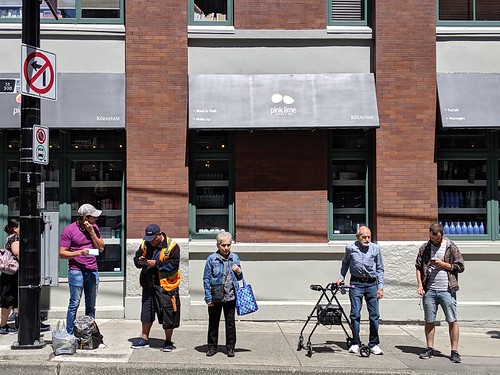
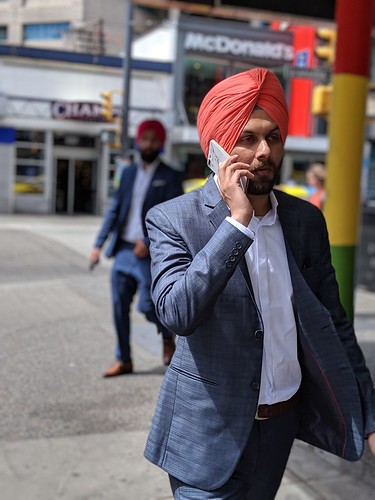
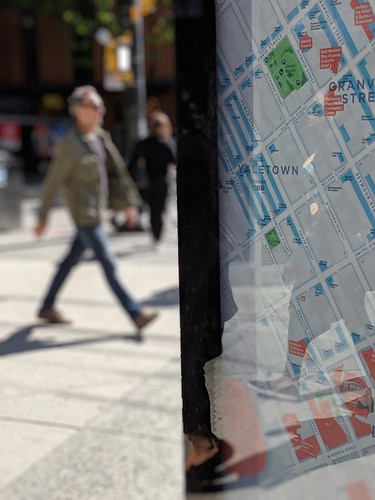
Vancouver 2019
I've shied away from this style as I - arrogantly to be honest - find it hard to make it individual to me and not too generic. However using a mobile phone without changing any settings pre or post let me work in the fluid way I enjoy with my camera (that in the moment thing) and feel more excited about the making process as well as the resulting picture. Yes I still like to see them as two separate parts! 
Vancouver 2019
I like the results. The images themselves are a - small - change in direction but they also represent a way of working I should consider in London too.
Vancouver 2019
They are still one-off pictures in a travelogue style but in the same way I've built a narrative around my more recent work it's perhaps a way of looking at other ideas. Short stories, not novels.

4 Jun 2019

desert island pics

My photo group was recently set a challenge to choose our Desert Island Pics. If you're not familiar with the phrase it's based on there's a nice summary here  
As I'd be thrown by choosing 8 pieces of music then 8 photographs was I'd say even harder. The format of the show is to tell the life story of the guest and the music often relates to particular moments so I chose to pursue that approach rather than select a set of fantastic images that really didn't mean anything personal to me.  
That said I did look at family snapshots as very much part of my story. An interesting point of departure from the music route as I've rarely heard home recordings selected.  
Anyway. Where to start?  
Well as I've mentioned before growing up in front of a black and white TV gave me a particular perspective on the world. I do remember old American comedies - excuse me movies - broadcast on Saturday mornings: Laurel and Hardy, Buster Keaton etc so I've chosen a famous still from a film by Harold Lloyd. I love the view of the city below. It obviously adds to the drama but for me it's a window on the everyday world below. In retrospect - I'll be doing a lot of that here - it plants a seed for my interest in America and cities in particular
Harold Lloyd film
Harold Loyd in Safety Last!, 1923
I can't leave this period with acknowledging film noir. There are so many to chose from but this is a memory from a Sunday afternoon. We're in front of the telly again. Turned down low while my mum and dad rest after their working week. On comes a film set not in Chicago or Pittsburgh but in Belfast. The atmosphere is tense. We're following an individual in real time with odds stacked against him. The city has a personality of its own, Swaying passionately from violence to humour. I'm transfixed. It's called Odd Man Out by Carol Reed starring James Mason. Watch it.
Odd Man Out film
James Mason in Odd Man Out, 1947 
OK so now I'm a little older. My first time living away from home. I've a bedroom wall to decorate. What do I put on it? Pop stars? Political manifestos? Family photos? Nope. Pictures of sports photography cut out from the newspaper and mounted neatly on card. Yep. What can I say. Eamonn McCabe was the premier sports photographer of the time and  I remember looking forward to seeing his pictures in the Sunday paper. Here's one of Bjorn Borg that was on my wall. although I must admit to fancying myself as more of a McEnroe.
Eamonn McCabe
Bjorn Borg, Eamon McCabe, 1978
Doing this exercise now it's interesting how significant photography was in my upbringing but how I made no real effort to pursuing it as a career. Put it down to an academic education, absence of any peer support or simply lack of self belief. Anyway next pic. Sorry for the self reflection but hey it's my blog.
We're now in Leeds and there are two images I've chosen to represent that period in my life. Apologies still back and white. We're going back a bit but I believe colour had been invented by now. 
I never saw The Clash (although Mick Jones played an important part in my later life) let alone any bands I should have done in that tumultuous era. However I did buy the album! Two in fact as the were selling for 99p each in a bargain bin and I gave one to my friend Paul. This is getting very Adrian Mole. Here's the cover photograph by the great Pennie Smith.

Pennie Smith
 London Calling, Pennie Smith, 1979 
I remember the university library at Leeds had two photography books, Minamata by W Eugene Smith and the other was I think by Don McCullin. By now I'd started taking photographs around Leeds with my first proper camera a Zenit and my style evolved with what I saw around me. Bradford wasn't far away and at the time the National Museum of Photography, Film & Television had recently opened there so my self-education continued inside those walls and outside on the streets surrounding it. McCullin's work had particular resonance and I devoured his work to the point of forfeiting my fare home to London to buy his book on Beirut.
Don McCullin
Bradford, Don McCullin, 1979
So my life took another turn after Leeds and the fulfilment of a dream to see New York City. Music was again a stimulant. Seeing Stop Making Sense at the Hyde Park Picture House wasn't quite Buzzcocks at The Free Trade Hall but the spectacle of David Byrne propelled me to go.
David Byrne
David Byrne in Stop Making Sense, 1979
I've chosen two photographs to represent my time there.  
The Village Voice became a staple read for me every week and the work of one photographer in particular stood out. Sylvia Plachy's Unguided Tour column eloquently captured the energy, madness and passion of the city around me. 
Sylvia Plachy
Unguided Tour, Sylvia Plachy
At the time I still really hadn't discovered the canon of street photographers that are now so well known. My education was browsing book stores and going to see exhibitions and at that time there wasn't a great deal on offer. One day a book called Invisible City caught my eye. The photographer was Ken Schles. As Plachy represented an exuberant exterior life of the city Schles refracted an underground perspective that I was also conscious of. 
Ken Schles
Invisible City, Ken Schles
Oops. I've got to 8 and I'm just into my twenties. I knew this would be tough. So what's this telling me? Well after that period I settled into developing the style of work you see today and is actually picked up at the start of this blog. Would I choose some of my own work - public and private - to represent that later period in addition to other photographers? I certainly think so. 
All the pictures - except one - are black and white. I need to keep breaking that upIn addition only two pictures are by women and they're all from a white western perspective. I think my later selections would have a range of far richer source as I keep learning about new photographers and practices. 
So I could have picked the most influential, well known photos over the same period but I think sitting on my desert island, wondering what on earth I'm going to cook for supper, looking at these particular images will kindle some important memories. 
Excuse me while I choose the next 8 and see if I can smuggle them with me too.

24 May 2019

home again

I'm always interested in work of Irish photographers so I was really pleased to see Eamonn Doyle and his collaborators speak at Photo London last week, just after I discovered The Republic by Seamus Murphy. I'm shamefully late finding out about Murphy's work so I have to thank Ben Smith's Little Voice podcast. Recommended listening.
Each of their bodies of work are fascinating - and timely - for me. As well as my ongoing project on European citizens, this year's show for my local photography group is on the theme of Home which I'm using as an opportunity to think about my own roots.
My mum Kate passed away two years ago. A migrant from Galway in the 1950s as my dad was from the north of Ireland it was a given for me that she'd be buried in the place she was born and raised in. The word home was always understood in our house as Ireland. On reflection it's an obvious sign of the dislocation of our lives.
To portray that in a single image presents a challenge, for me at least but hey it's one of the reasons for joining the group. I could look at constructing an image, perhaps a still life of an object, to symbolise my emotions. Perhaps it's more of a collage of different elements. Yesterday I heard a word I hadn't in a long time. Kaleidoscope. It really brought back a memory of one I had as a child. As well as the act of losing oneself in a miniature world of shifting shapes it had a maracas-like quality when you shook the little crystals inside. Simple pleasures.
image of gate,field and tree
An alternative route, inevitable in a way, is a landscape image. I say inevitable as land has both political and personal resonance, as it has I'd guess for many emigrant people. It's the place you left and yet it still has a magnetism that draws you back, sometimes despite yourself. 
I've taken landscape before as holiday snaps, scenic views for the record, with a visual language of fine art oil paintings. None that I ever feel really engaged in the way I do my city pictures. Too proud a townie to be bothered with nature. Perhaps it's time to revisit that. 
The Republic Book Cover
Murphy's book is inspiring for me in this regard. I just needed to see the cover image and it was interesting to hear him talk about that on the podcast as it appeared at a moment when he had real doubts about continuing the project, about his work being good enough to justify its subject. Like a vision he came across this particular stretch of road - that he could never find again - and he was on his way.
Eamonn Doyle's Made In Dublin
Doyle's work really made a splash about five years ago and I was really pleased to see the manner of how he presented his work firstly at Arles and now when I saw it in London. I've considered how to present urban/city/street work and never felt comfortable with a purist white wall gallery experience. In fact my first effort back in the late 80s was at a former synagogue in Spitalfields where I photocopied and pasted my pictures across sheets of re-purposed corrugated iron in the basement. A reasonable DIY first attempt at an installation but writing this now has really made me think of what more I could (still?) do.
I wasn't aware, ignorantly, again, of K a subsequent project by Doyle inspired by the death of his mother Kathryn. It's in a way figurative but certainly of the landscape as well. The result is an imaginative contemplation of a woman's life. Something personal but co-created with two friends as a multi-sensory piece of work.
So all in all a timely - as always - intervention of art and life. I wonder if photography for me is less about making sense of the world around me and more about making sense of myself. 

Or does everyone think that.

Do you?


22 May 2019

tell me a story


I've just experienced the most remarkable evening of photographers discussing their work. A new initiative called the Photojournalism Hub brought together Rob Pinney, Giovanna del Sarto, Tavis Bohlinger and James Hopkirk to tell the stories of their work. They each well met the ambition of the evening to expose and engage pressing social justice issues through committed and courageous photojournalism.
Refugees' experiences connects the work of Rob Pinney and Giovanna del Sarto but each of their approaches are distinctive. Pinney's searingly honest description of his initial emotions at The Jungle in Calais and the evolution of his work as he became more familiar with the people - camp refugees and town residents - and their codes of behaviour was fascinating. 
Del Sarto's work explores the power dynamic between photographer and subject, turning it around in her Polaroid for a Refugee project. Recognising the significance of family photographs in the journey into the unknown, the act of taking - then giving back - an image with the commitment to follow its path is incredibly powerful.
The next story took us inside a very personal reflection by a father on his son's journey with autism and epilepsy. Tavis Bohlinger's The Epileptic felt like a real time commentary on his emotional struggle in dealing with what was happening to his son by having the presence of mind - such an apt phrase - to make a photographic record of his interactions with health carers. Using them to interpret the impact on his son of this process was both harrowing and insightful and, as someone with family impacted in the same way, thought-provoking.
The final story was another dimension to the refugee journey, that terrible period of uncertainty once arrived of being granted permission to remain. The Blood of a Woman by James Hopkirk is far more than a documentary project. His involvement with the issues raised by following the story of Mirela cross the traditional boundaries of the objective photojournalist but for me represent a far more humanist approach than the questionable practices of some contemporary photographers.
Do spend time with each of these stories. They are all inspirational. 

19 May 2019

insta fame

Well I've enjoyed my 15 minutes of fame this week c/o a post on Instagram and a chance (more of that later) meeting with Matt Stuart outside Tottenham Court Road station. 
I first met Matt many years ago when he - and others - were conceiving In Public arguably the first collective of street photographers. I was oblivious to the fact that I was the subject of a selection process for the group and had simply appreciated the chance to meet some like-minded souls! In a nicely circuitous way I've now found myself recognised under the flag of new name of the group Un Public whose Instagram account Matt's currently curating.
Unpublic Instagram
I was really interested in Matt's selection of a set of images from my website. Of the 10 only one is recent and to be honest does "fit" well with the older ones.
One person with arm around him
Without dwelling on it too much - as if - it's a useful piece of insight into how I'm trying to develop my work with the New Europe project and how I can balance those standalone images with less obvious ones that are developing that story.
Oh yes. Chance. Yes I'd seen that Nick Turpin, the other driving force behind In Public was in town the same day and thought about trying to meet up with him but in the end found myself on Oxford Street with a real sense I was going to see someone. Well my street photography diving rod was obviously on to something when I saw Matt.
There you go. It's all street.

11 Apr 2019

looking at me?

In vain I'm trying to control my collecting of books, in particular ones which reflect city street life, especially London, so I try to choose ones with an original take. I'm pleased to say Nigel Shafran's The People on the Street is one of those.  
Like a lot of great ideas, it's very simple. It's becoming more common to encounter homeless people on the street. For me they have no choice in the matter so I don't purposely take pictures with them as a subject, however in its own way that's ignoring their existence. There's already an argument that self censorship in this way will mean future generations won't have a record of children on the street so I like seeing projects where they can document their own lives. Following similar logic Shafran empowers homeless people by giving them a camera to take pictures not of themselves but of himself.
People on the street book cover
The resulting book is a powerful commentary on a societal responsibility but also, if it's not too indulgent, on documentary photography itself. There's an important debate about the best photographic practice in documenting people's lives all around the world which doesn't simply objectify them or worse. We're not now living in a time where Life or National Geographic ran photo stories of exotic other worlds, reinforcing stereotypes of difference, and yet that form of representation is hard to shake off. Homeless and, more broadly, other disadvantaged people occupy a similar status of otherness in this country today whether that's a kind of "by the grace of god" or "it's their own fault" attitude. It's worth mentioning two other current UK photography projects that directly address this, J A Mortram's Small Town Inertia and Paul Sng's Invisible Britain. Not worthy or patronising photographs. Work that's part of a broader context of social engagement and change. Inspirational stuff.

26 Feb 2019

the day the earth

The sun's splitting the stones in London and I'm torn. Sun is the prime ingredient of my photography. So what's the problem? It's February and I'm out on the streets, a month ahead of schedule. That's the problem. 
I confess I'm already uncomfortable with the environmental impact of using film. Now I'm facing up to fact I'm literally fiddling while the world burns. Movies set in the future but made in sixties had a big impression on me, especially, no surprises, ones set in London.
Now I'm wondering if my work is becoming more like a nature documentary. The sun is so strong yet still low in the sky. Shadows are still relatively cold. People wear sunglasses, shorts...and scarves. We're in the headlights. Transfixed by the sun, knowing the danger but compelled to stare. 
London 2019
Oh yes and London had a high pollution alert today. Apart from the risks posed by couriers, security guards and manhole covers I do wonder if particulate exposure is an occupational health hazard of street photography. That's if the sun doesn't get us first.. 
Stay safe. 


29 Jul 2018

open city?

Rome has been in my sights for a while now. 
Perhaps it's the influence of William KleinRoberto Rosslini, or even Francesco Totti but it also has present day relevance at the front line of the debate about immigration, nationality and citizenship. 
My series New Europe is a personal reflection I've been developing around the context of my pictures. Not the specific location or time of day. Still respecting the anonymity/ambiguity of people. Back to one of my favourite words, palimpsest. Another layer of interpretation, of possible meaning, that intrigues me.
link to Rome contact sheet 
Anyway. It's a good opportunity to show a contact sheet and start the post-conception phase I enjoy! 


10 Sept 2017

tag time

Really pleased to participate in the Tag exhibition with my local London Independent Photography group. It's great to see thoughts that I explored in my Ambiguous book project come to life in a collection of images that ducks and weaves through urban, portraiture, landscape and still life across city, town and country. 
Tag exhibition image
A big bonus is the decision to print all the images in black and white. Without any influence from me, honestly! I actually wonder the difference colour would have made in the connections that each photographer has made. Monochrome's ability to accentuate the composition of an image featured in a number of interpretations. Would colour have led to more emotional responses? I recognised my initial rational response to the images I had to work with but actually enjoyed letting my mind wander...hey I'm a flaneur, right?
It's a well worn topic I know. Black and white was regarded as having a greater truth, whatever that may be. Colour was ironically too much like reality. In a way less art, more artisan. I don't recall making a conscious decision, like with a lot of things, to choose black and white. It's just how I see the world. 
Tag exhibition image
As well as responding to a brief I also enjoyed the challenge of working against the clock. Almost like a real photographer!  
To give each participant sufficient time to respond to their image meant a turnaround time of a week for each photograph. No big deal for digital, not so straight forward in the analogue world. I've come to enjoy the related but distinct parts of my image making process but they don't lend themselves to speed, in fact quite the opposite. For this project I had to condense months into a week and, thanks to the wonderful print work of Stuart Keegan, managed to do that. Phew!
Tag exhibition hanging
The format of the show is the final part of the experience I really like. Prints hung by fish wire and bulldog clips it appeals to my sense of how photography doesn't need to follow traditional gallery practice. Making it accessible in such a way that doesn't undermine the work but removes barriers to viewers, both mentally and physically, is really important to me. In fact it's one of the attractions of using new technology to create work that appeals to me.
That's how I like it. Beginnings not endings.


10 Aug 2017

Tokyo 360

I've been toying with new ways of working. Film will always have a special place and it's been wonderful to fall back in love with it again over the last year. 
Singular focus and dedication to a cause, the 10,000 hours story, has its merits. That perfect shot is just around the corner, it has to be...surely? I confess at the same time it becomes a comfort zone. I've taken the plunge into digital, although just through a camera phone, dallied with video and so next up is the wild west of 360.
Link to 360 Tokyo images
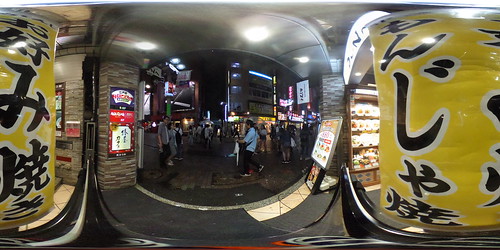
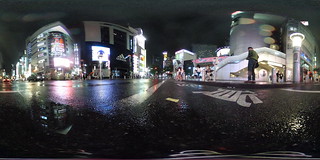
A trip to Tokyo seemed the perfect opportunity. A collision of ancient and modern, Blade Runner in a petri dish. 
How did it go? Well it's certainly out of my comfort zone! Pretty much every maxim I follow is quite literally turned upside down. 
Link to 360 Tokyo images 
Is it street? Absolutely. As you immersive yourself in the image you are in the moment as well as outside it. A participant and an observer. Part of a bigger story. 
That's life. That's street.

9 Jul 2017

looking for a new Europe

My reflections at the end of last year have led me to looking at my work in a bigger context. For a long time I resisted any kind of interpretation of my work. Hey this blog was the cause/effect of doing just that.
My idea is to develop a body of work around people in cities – no surprise there – but recognising Europe is in a particular period of change. European cities were in the vanguard of the first waves of urbanisation. They are now the destination for another mass movement of people. So far so good. It's how they've historically grown and prospered. This time things are different. Attitudes and assumptions are being challenged. The essence of what it is to be a citizen is being fought for, intellectually and physically.    
link to new Europe images 
I’ll say up front my pictures aren’t documentary in terms of taking a journalistic approach. These are more personal which I appreciate can be a euphemism for self-referential shoe-gazing. As if.
My angle on this story is an appreciation in some way of what it is to be a child of Irish immigrants. Granted with the privilege of blending in but still with an appreciation of what it is to be an outsider. 
There’s no set plan or timetable yet. I’ll share work in progress here. I’m also interested in other forms of presenting it. I’m not rejecting books by default but hey it’s 2017 and other ways and means are possible. 
Wish me luck.

21 Nov 2016

things fall apart

Caption. Just a few words about the picture please. How hard can it be? Yet my love of photography - and street in particular - is that its meaning is open to the eye of the beholder. No nudges or hints necessary. Just breathe in and breathe out. Simple.
Perhaps it's my Irish roots but this year had a particular significance even before it began and the last 11 months have compounded that dramatically. I was looking back at my work over the summer, at two images in particular. Ordinarily they'd be filed as candidates for the next part of the journey but bringing them together is as close as I ever have to making a statement, however oblique, about my take on the images.
link to 2016 part 1
link to 2016 part 2
What's that you say? Where's the caption? 
Let's make it a quote from W.B. Yeats
Turning and turning in the widening gyre
The falcon cannot hear the falconer;
Things fall apart; the centre cannot hold;
Mere anarchy is loosed upon the world,
The blood-dimmed tide is loosed, and everywhere
The ceremony of innocence is drowned;
The best lack all conviction, while the worst
Are full of passionate intensity.
End of sermon.

14 Aug 2016

untouchability

I've rekindled my love of books about cities reading Cosmopolis by Don DeLillo. Set in New York City it bridges my last post well...
He felt the street around him, unremitting, people moving past each other in coded movements of gesture and dance. They tried to walk without breaking stride because breaking stride is well-meaning and weak but they were forced sometimes to sidestep and even pause and they almost always averted their eyes. Eye contact was a delicate matter. A quarter second of shared glance was a violation of agreements that made the city operational. . . No one wanted to be touched. There was a pact of untouchability here.
Using my phone has changed my technique out of necessity rather than deliberate choice. My from the hip style reflects a covert/non-confrontational/sneaky/zen-like (delete as you wish) attitude. Working with my phone necessitates a precise touch on the screen to take a picture: simply speaking I need to bring it to my eye level...and subsequently to that of the photographed too. 
link to image
And my problem is? Well, as DeLillo says, eye contact is a delicate matter, a pact of untouchability. To break that is to tear the veil we share between us. A touch melodramatic? Perhaps but I have found this "new" way of walking as exciting as any period of my work. 
Bear with me while I find my feet again!


21 Jul 2016

still looking at me

Another return after a break. This one almost 30 years. Back to where it all began. 
I certainly had mixed feelings on my return to New York. My fears of a sanitised city were unfounded though. Manhattan, its people and its streets, I'm glad to report are still alive and kicking against the pricks. I found Times Square and my old rat runs as stimulating as the first time.
Here are some rough cuts of some ideas in progress. 
Do not adjust your monitor. Yes they are colour and digital. 
Have mercy.
link to street photograph
And here's a quotation I heard on the radio one morning
We shall not cease from exploration, and the end of all our exploring will be to arrive where we started and know the place for the first time.  TS Eliot
Feel there's another book in the making here...


4 Jun 2016

finding my feet

Ah there you are, now were was I?
It's been a while since I posted but don't worry I'm still here. Still snapping. Still street. Still, well, still.
My latest project is called Finding My Feet for both literal and metaphoric reasons. I found myself with an opportunity to spend some dedicated time back on the streets of London this year. I'd never stopped seeing street. I just needed to start remembering it again. Tool of choice, as a way of getting myself back in the game, was a digital phone. Heresy? Well maybe I'll have to revisit my classic recipe for street photography and make it a little more nouvelle...Interestingly enough my analogue style has translated without too many adjustments. 
link to London street photographs

It's a work in progress. That's the nature of digital. That's the interesting part for me. Will the infinite overwhelm the finite.
I hope to find out!

20 Feb 2012

portrait of a street photograph, part 2

Well I've made an edit of the images from Barcelona which, on a cold, dark day in London, is a welcome tonic! One of the consequences of the gestation of my work is an appreciation not only of the passage of time but of season in particular. The scraps of sunshine in the winter city are both a promise of days to come and a reminder of the capriciousness I'm at the mercy of.
I'm really happy the potential mise-en-scene of the contact sheet I was particularly occupied by has been realised. This is a first for me! I've left out the don't go back ingredient of my own recipe for street photography. Before now my experience has been that I can never beat that initial, gut response to a possible picture. Any second attempts become 3T: too thought through
link to Barcelona image
On this occasion I managed to keep the spontaneity of the first contact and, by turning the dance of the street to my advantage, come away with two images that both stand alone and together.

link to Barcelona contact sheet
Hope the London saying about waiting for a bus for a long time and then two come along together will be true for me. Twenty years will be a long time to wait for another such opportunity!

See more sunshine here.