Showing posts with label influences. Show all posts

17 Feb 2022

tale of two cities

As restrictions in London ease it's wonderful to have the opportunity to see some photography in real life. Two shows caught my eye to mark my return. They were, guess what, a throwback to black and white work from the fifties and sixties, an era that first stimulated my passion for photography.

The location of the shows were in many ways the antithesis of their roots. Swish, exclusive art dealers in London's Mayfair district are a long way from Roy DeCarava's roots in Harlem and Mary Ellen Mark's work in Seattle. 

I remember seeing Mary Ellen Mark's photography as part of a wonderful show in 2018 at the Barbican, Another Kind of Life. There the context and stories of the participants were very much part of the experience. The way her work was displayed in Alike, My Friends, was strangely disconcerting. Stripped of any title alongside the image in such a body of humanist work felt wrong. Commoditised. Oh yes the titles could be found. In the price list.

Burlington Gardens

Walking past the Royal Academy and along New Bond Street my emotions were mixed. There was certainly an energy and buzz. Maybe it was the aftertaste. The haves and the have-nots have always been woven to form the fabric of London. However the latest iteration feel more monochrome.  

So I was concerned entering the next show. I've held Roy DeCarava's work close to my heart for a long time. I remember buying a monograph in the old Photographers' Gallery bookshop on Great Newport Street when that was really the only place I knew to educate myself. 

 Grafton Street

It was a relief to enter the space at David Zwirner and find the work presented so well. It's still a "selling" show but classy. It helped that the late afternoon winter sun  gave an ambience and warmth that literally gave life to the work. 

Faith restored.


20 Aug 2020

take a walk on the southside

Books - as well as virtual tours - are a great resource for me right now so I was so pleased to see Paul Treacy had created another wonderful handmade book of his life in south east London.


I've written about his work a couple of years ago when he published SE26. I suppose it's one of the benefits - for me at least - of this blog that I can take time travel back to my state of mind over the last ten years and in a way a long time before that too.

I was thinking then of my roots and that concept is very much back on my agenda, courtesy of our current hyperlocal lifestyles. I identify with London, of being a Londoner. Although I'm not quite sure what that means right now. Where I was born in an area of south east London - not central, not suburban - gave me an outsider's perspective of the city. Reinforced to a large degree by my parents' status and a big motivation behind my photography. I've since started to appreciate where I live now in west London over the last few months....again through the medium of photography. 

The outsider-ness is still present (I blame reading French existentialism at an impressionable age) so maybe that's here for good now but to be honest I feel I need to dig a bit deeper, beyond my surface and that of the world around me. The New Europe project was a step in that direction. 

I need to keep walking. 


4 Jun 2019

desert island pics

My photo group was recently set a challenge to choose our Desert Island Pics. If you're not familiar with the phrase it's based on there's a nice summary here.   
As I'd be thrown by choosing 8 pieces of music then 8 photographs was I'd say even harder. The format of the show is to tell the life story of the guest and the music often relates to particular moments so I chose to pursue that approach rather than select a set of fantastic images that really didn't mean anything personal to me.  
That said I did look at family snapshots as very much part of my story. An interesting point of departure from the music route as I've rarely heard home recordings selected.  
Anyway. Where to start?  
Well as I've mentioned before growing up in front of a black and white TV gave me a particular perspective on the world. I do remember old American comedies - excuse me movies - broadcast on Saturday mornings: Laurel and Hardy, Buster Keaton etc so I've chosen a famous still from a film by Harold Lloyd. I love the view of the city below. It obviously adds to the drama but for me it's a window on the everyday world below. In retrospect - I'll be doing a lot of that here - it plants a seed for my interest in America and cities in particular
Harold Lloyd film
Harold Loyd in Safety Last!, 1923
I can't leave this period with acknowledging film noir. There are so many to chose from but this is a memory from a Sunday afternoon. We're in front of the telly again. Turned down low while my mum and dad rest after their working week. On comes a film set not in Chicago or Pittsburgh but in Belfast. The atmosphere is tense. We're following an individual in real time with odds stacked against him. The city has a personality of its own, Swaying passionately from violence to humour. I'm transfixed. It's called Odd Man Out by Carol Reed starring James Mason. Watch it.
Odd Man Out film
James Mason in Odd Man Out, 1947 
OK so now I'm a little older. My first time living away from home. I've a bedroom wall to decorate. What do I put on it? Pop stars? Political manifestos? Family photos? Nope. Pictures of sports photography cut out from the newspaper and mounted neatly on card. Yep. What can I say. Eamonn McCabe was the premier sports photographer of the time and  I remember looking forward to seeing his pictures in the Sunday paper. Here's one of Bjorn Borg that was on my wall. although I must admit to fancying myself as more of a McEnroe.
Eamonn McCabe
Bjorn Borg, Eamon McCabe, 1978
Doing this exercise now it's interesting how significant photography was in my upbringing but how I made no real effort to pursuing it as a career. Put it down to an academic education, absence of any peer support or simply lack of self belief. Anyway next pic. Sorry for the self reflection but hey it's my blog.
We're now in Leeds and there are two images I've chosen to represent that period in my life. Apologies still back and white. We're going back a bit but I believe colour had been invented by now. 
I never saw The Clash (although Mick Jones played an important part in my later life) let alone any bands I should have done in that tumultuous era. However I did buy the album! Two in fact as the were selling for 99p each in a bargain bin and I gave one to my friend Paul. This is getting very Adrian Mole. Here's the cover photograph by the great Pennie Smith.

Pennie Smith
 London Calling, Pennie Smith, 1979 
I remember the university library at Leeds had two photography books, Minamata by W Eugene Smith and the other was I think by Don McCullin. By now I'd started taking photographs around Leeds with my first proper camera a Zenit and my style evolved with what I saw around me. Bradford wasn't far away and at the time the National Museum of Photography, Film & Television had recently opened there so my self-education continued inside those walls and outside on the streets surrounding it. McCullin's work had particular resonance and I devoured his work to the point of forfeiting my fare home to London to buy his book on Beirut.
Don McCullin
Bradford, Don McCullin, 1979
So my life took another turn after Leeds and the fulfilment of a dream to see New York City. Music was again a stimulant. Seeing Stop Making Sense at the Hyde Park Picture House wasn't quite Buzzcocks at The Free Trade Hall but the spectacle of David Byrne propelled me to go.
David Byrne
David Byrne in Stop Making Sense, 1979
I've chosen two photographs to represent my time there.  
The Village Voice became a staple read for me every week and the work of one photographer in particular stood out. Sylvia Plachy's Unguided Tour column eloquently captured the energy, madness and passion of the city around me. 
Sylvia Plachy
Unguided Tour, Sylvia Plachy
At the time I still really hadn't discovered the canon of street photographers that are now so well known. My education was browsing book stores and going to see exhibitions and at that time there wasn't a great deal on offer. One day a book called Invisible City caught my eye. The photographer was Ken Schles. As Plachy represented an exuberant exterior life of the city Schles refracted an underground perspective that I was also conscious of. 
Ken Schles
Invisible City, Ken Schles
Oops. I've got to 8 and I'm just into my twenties. I knew this would be tough. So what's this telling me? Well after that period I settled into developing the style of work you see today and is actually picked up at the start of this blog. Would I choose some of my own work - public and private - to represent that later period in addition to other photographers? I certainly think so. 
All the pictures - except one - are black and white. I need to keep breaking that up. In addition only two pictures are by women and they're all from a white western perspective. I think my later selections would have a range of far richer source as I keep learning about new photographers and practices. 
So I could have picked the most influential, well known photos over the same period but I think sitting on my desert island, wondering what on earth I'm going to cook for supper, looking at these particular images will kindle some important memories. 
Excuse me while I choose the next 8 and see if I can smuggle them with me too.

26 Jan 2019

renga time

I'm thinking of making a zine with the photographs from my New Europe collection. Why zine? Wouldn't it be an opportunity to add to my fabulous publishing empire? Well I'm seeing this as a punctuation point not an end. This is still very much a work in progress, as is the immigration debate itself of course.
I have to credit my friend Fabrizio from my local LIP group for the inspiration as he has used the zine format to really complement his wonderful work. 
One characteristic of a zine I like is that you can do away with the reverence of the high end reproduction values of a book. For me it's a more accessible way of presenting images and their sequencing in a visceral way that can really engage you. It reminds me of my conscious rejecting of what I called the white gloves school of photography back in the day. For me the word zine recalls the work of Jamie Reid. In no way could I call myself a punk but the DIY ethos of creating art - whether music, design, film or photography - of picking up whoever or whatever is around you and expressing yourself is really vital to the individual and society.
Zine planning
This is also another opportunity to do something different to how I've worked before by collaborating on the selection and flow of my pictures. Typical of my practice it's always been a solitary process. I had a foray into collaborative working thanks to the Ambiguous Book Project which was quite magical so the seeds are there. This time I'm keen to use the process to interrogate my own work.It's taken me time to feel comfortable doing that myself so I'm excited...and a little nervous.
Fabrizio and I have shared our separate experiences of taking photographs in Tokyo and so listening to the radio this week I was caught by the Japanese phrase Renga.  It's a genre of collaborative poetry but for me it captured perfectly what I'm trying to do...and I never miss an opportunity to see serendipity.
Kore wo yarimashou!


30 Nov 2018

nocturne

I've eased the transition to post-season by going to some talks by photographers about their practice. Being me there's a London angle to them of course. 

I welcomed the opportunity to revisit the London Nights show at the Museum of London. Both it and the talk gave me such inspiration I was propelled into the streets outside. There's a tension in my relationship with the City. I love the diversity of the West End versus the homogeneity of the street life of the square mile however I can't deny a fascination with its historical context. To that end it was inevitable I was drawn to an icon of the show, St Paul's Cathedral.
It's hard not to look at the image of St Paul's featured in the show in the midst of the Blitz by Herbert Mason in the context of today's debate about Britain's role in the world. It's suffused with a sense of standing alone against European tyranny and it's propaganda value is just as powerful today as in 1940. So it was with fascination I found in its grounds a funfair that had been installed for the Lord Mayor's Show that weekend contrarily, or perhaps not, shared with the 100th anniversary of Armistice Day.
St Paul's photograph
The carousel's seats, occupied by cut-out figures swaying lifeless in the wind and rain presented too easy a metaphor for the current political climate. However the role of the night was the dominant feeling for me. The darkness accentuated the spot-lit dome like a surreal inverse of a wartime blackout. The only sound was of the wind through the carefully placed trees. The amusements observed their own embarrassed silence, knowing it wasn't the time or the place to hook a frog, prize every time.  
All these sensations were in stark contrast to my daytime experience of London and they were brought to the surface again thanks to another night-time talk, this time on the other side of the City in Aldgate. 
After hearing Tom Hunter passionately give London Independent Photography's annual talk (reminding me of another Hackney advocate) I was drawn to wander the streets outside around Petticoat Lane in the shadows of the office blocks and converted warehouses of Bishopsgate. 
Petticoat Lane photograph
Despite the encroachment on all sides those streets still bear some testimony to another London. One well documented by some of my favourite photographers so there was undeniably a feeling of nostalgia but also one of embracing the future. As much as these new buildings represent life for the few not the many London, indeed any city, is constantly in flux.
Like months to a flame people are drawn here.

3 Mar 2018

street philosophy

I see a new book on Garry Winogrand is about to be launched. Written by Geoff Dyer whose book The Ongoing Moment I really enjoyed for his lateral take on the history of photography I'm sure it'll be a good read.
Garry Winogrand is such a go-to reference for what I'll call classic - and others may call old fashioned - street photography that it's curious I honestly was not aware of his work when I started practising. Apologies if that's disingenuous. I can see my work reads like a Winogrand-lite tribute act. 
Oxford Street photograph
But my inspiration I recall was through the documentary work of Don McCullin's Homecoming and W. Eugene Smith's Minamata. Back in the day what became known as street wasn't publicly available, in the UK at least. Yes it feels a little sepia toned even writing this. Let me fetch more ink for my quill...
At that time I actually made this type of work, in style and in conscience. Now, in retrospect, it's one of those what-if questions about life (in)decisions. I know I struggled with the anthropological/us & them approach to documentary work which I why I admired for example Jim Goldberg's Rich and Poor project that found a way to break down the viewer/photographer/subject relationship into something fresh. 
I have to accept my own style can easily be seen as making no challenge to those relationships. There's no collaboration between myself and what I photograph. They are still subjects. I seek no deeper insight into their condition. My only only nod to objectivity is not to caption the picture. And yet it's that very ambiguity that I find fascinating and enduring. Geoff Dyer comments in his book on a particular Winogrand photograph from the late 50s/early 60s
In colour, people seem necessarily to be walking into the future (when the overwhelming bulk of photography will be colour); in black-and-white, they are emerging from the past (when black-and-white was considered the only medium for serious photography).
It's a question I've thought with regard to my own work. Is it simply a nostalgia trip, a re-tread of old tropes that were new and radical back in the day but now really saying nothing new? I've fallen back on on jazz, one of my favourite comparisons, and the way that standard compositions can be endlessly re-interpreted. I guess the challenge for me is to stay Miles Davis and not Kenny G...
New York City 1987 photograph
Tokyo 2017 photograph
I'm now looking back at my work from thirty years ago and, yes, those people are still emerging from the past...as they are from last year too. Does that continuity, that plus ça change, say anything worthwhile? I hesitate to use the phrase human condition as for me it's rooted in that black and white world of Life and Picture Post photography that in a contrary way reinforced social stereotypes while ostensibly celebrating them. But hey are we any more sophisticated now? 
Perhaps I just need to appreciate these pictures for what they are. Tiny breadcrumbs of my life. Watch out. Sounds like a book title...


24 Jun 2017

street music

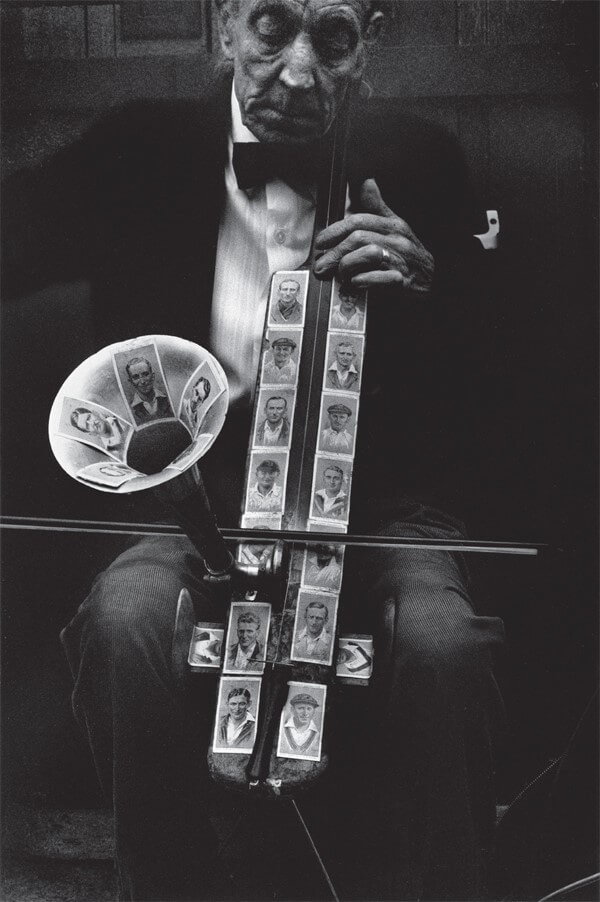
Wonderful to see Markéta Luskacová in conversation at the National Portrait Gallery this week with my friend Paul. She's an inspirational figure for me and her work in 70s London really does feel like another country where they do things differently. It was really apt to see her with Paul who played a big part in the development of my own ways of looking at the world.
Markéta Luskacová’s London Street Musicians
               London Street Musicians, Markéta Luskacová
I'm always fascinated by how people go about pursuing this passion in relation to the real world of making a living and looking after a family. Markéta's description of taking her son in his push-chair on her trips around Brick Lane was a wonderful illustration of the compromises made. 
Her story is also a timely reminder of the role of immigrants in London's growth as a world city. Undoubtedly Markéta felt a cultural affinity with the musicians she photographed but their outsider status reflected her own experience.
Buy her books! 

22 Sept 2011

life class

It was wonderful to give another talk at The School of Life earlier this month. Many thanks to Nick Turpin and the participants of the Photographing London weekend workshop for a really inspirational afternoon.


I am impressed at the quality of work at these sessions. Once again it's a real lesson for me in setting oneself parameters or a challenge. Inevitably I search for a metaphor in these instances and the mental and physical effort required is certainly of Olympian proportions.

Two marvellous images are worth noting from Laura Fitzpatrick and Tony White. Each in their own way exemplify for me the essence of street photography.

Tony's image, and style now I'm glad to have discovered more of his work, has a real warmth and a resonance with the sensitivity of Tony Ray-Jones. There's certainly an undefinable Englishness to this picture which is a joy.

In contrast Laura's photograph at the foot of Nelson's Column is a tour de force of geometry and timing. It feels so perfect that it ironically touches on contemporary practices of digital manipulation and staged flash mobs, even though the image is entirely of the moment, taken as found with no intervention other than being in the right place at the right time and having the presence of mind to take the picture.
Easy, eh?

2 Apr 2011

photographing London at the School of Life

Last week I had the pleasure of discussing my work with a wonderful group of people participating in a street photography weekend run by Nick Turpin at the equally wonderful School of Life in the heart of London.
The School of Life's strapline is "Ideas to live by". It was I felt a very appropriate venue to consider the practice of street photography which for me is characterised by its representation of every day life, one step removed. The 'takeaway' from my talk to the group was to simply appreciate the experience of coming off standby mode, where we live much of our lives, to a more switched on state where, to quote Ian Sinclair in Lights Out For The Territory quoting William S. Burroughs,
"...the important fact about urban living: the continual stream of second attention awareness. Every licence plate, street sign, passing strangers, are saying something to you."

I appreciated they'd had a tough weekend walking the streets of London, fulfilling stretching briefs set by Nick, but I hope this message had some resonance. The more I talk it through in front of people, the more it makes sense. To me at least.

It was fascinating to see each member of the group's different, and common, interpretations to the challenges they had been set. The idea of working as a pack in this way, sharing a common purpose but following your own instincts, is intriguing and not one I've experienced. There's an inherent contradiction for me in undertaking what is essentially a solo pursuit in this manner, but there are certainly photographers out there who practice in this way.
The Ambiguous Book Project has got me thinking about collaboration. It's a virtual project where every participant is working independently. Even more so when I'm asking them not to go out onto the street but to stay indoors and look at their personal collections! However we are still sharing an approach, reflecting on images and how they can reveal more than we may have originally intended. I wonder how we could develop that into a realtime, in person activity?
Hey look at me, already thinking of the sequel.That's a little way off just yet!

4 Dec 2010

street photography talk at Photofusion

I was fortunate enough to be invited to talk to a group of street photographers at a course run by David Gibson of In-Public at Photofusion in London last week. It was the first time I'd done something like that and I certainly hope those on the receiving end enjoyed it as much as I did.

In the spirit of this website I wanted to convey "the how" and "the why" of my work as much as the end product, the picture itself.
Preparing the talk lead me to review my work in a chronological way. Surprisingly to me, but perhaps inevitably, I couldn't separate it from my own journey, from the certainty of youth to the less than certainty of older age.

If you're interested you can see the pictures I talked about at the bottom of this entry.
I wanted to break up the presentation of my images with ideas that gave a little more background to my state of mind at the time so, before you look at them, I'll explain some of the more random ones...

I characterised my pull to the febrile atmosphere of New York City through the images of David Byrne, an icon of the New York art/music scene, and Telly Savalas, an icon of my misspent youth watching TV, the New York City detective Kojak. I could have gone on to include Andy Kaufman from Taxi and Gene Anthony Ray from Fame but I think I got the idea across...
The technique I'd developed, more by accident than design, was releasing the camera's shutter away from my body, requiring a degree of hand-eye coordination. Who better than the tennis player John McEnroe to represent that? Then, sticking with sporting metaphors and perhaps pushing them too far, I chose an image of the great Austrian skier Franz Klammer to represent my physical approach on the street of moving at speed but with control. Make sense? No, perhaps only to me.
The other images I've chosen are those of Shane McGowan and Viriginia Woolf. I admit I liked their juxtaposition but they also helped illustrate the part of my story where I've been influenced by musical and literary work.

The final pictures represent photographers I particularly admire. There are so many I could include but I chose these for my audience, ones which perhaps are not so obvious: Roy DeCarava, Ray Metzker, Daido Moriyama, Sylvia Plachy and Michael Ackerman.
You can certainly include Don McCullin in that group too. A photograph from his book Homecoming opens my talk.

There were some very good questions and comments which were really interesting for me, not having gone public in such a way before. I'll pick those up next time.

12 Nov 2009

books etc

I'm an avid reader of novels set in cities. My street photography is an act of turning a passing moment into something tangible and memorable. Inversely, the words of these novels, fixed on the page, fire up images and snatches of ideas in my mind.
I remember being struck by this passage from Paul Auster's City of Glass not long after I returned from living in New York City...

New York was an inexhaustible space, a labyrinth of endless steps, and no matter how far he walked, no matter how well he came to know its neighbourhoods and streets, it always left him with the feeling of being lost. Lost, not only in the city, but within himself as well. Each time he took a walk, he felt as though he were leaving himself behind, and by giving himself up to the movement of the streets, by reducing himself to a seeing eye, he was able to escape the obligation to think, and this, more than anything else, brought him a measure of peace, a salutary emptiness within.
I can also pick out particular themes that I respond to. For example Jonathan Glancey's London: Bread and Circuses, Iain Sinclair's Lights Out For the Territory and Will Self's The Book of Dave each, in their own way, depict a great sweep of London's history, past and future, factual and fantastical, that changed my perception of the streets I walk today, home of ghosts of the past and the future. Here's Jonathan Glancey's insight...

In a transcendental moment, I felt as if I was rising like some cockney sparrow or the spirit of William Blake and, looking down on my own city - one of the world's greatest - saw it boozing and shopping away its political conciousness as it bopped to the tune of a thousand advertising jingles. Two thousand years flashed before my eyes and I was standing in Londinium alongside a supercilious legate from Rome in a purple-edged toga. "Bread and circuses", he sneered. 
Novels written in the 1920s and 30s such as Night and the City by Gerald Kersh, Twenty Thousand Streets Under the Sky by Patrick Hamilton and, of course, Mrs Dalloway by Virginia Woolf have a relevance to my present day experience of the city, of an individual's daily life in the crowd, of dealing with universal emotions and issues, while negotiating the modern world. Patrick Hamilton describes a particular event that illustrates this experience for me...

Now there is an extraordinary allure in walking around, or hanging about the streets, in the vague hope of catching (and so justifying your rather bold expectations) one who has no thought of meeting you. You may, after a while, have lost all desire to see the individual in question, but at the same time you find a peculiar difficulty in behaving like a man and cutting a loss. Having gone to the trouble of trailing up and down six or seven streets, you are loth to lose your point for a ha'porth of obstinacy, and are almost convinced that the very street providence has selected for you is the eight. You therefore go up it. Then your eight will probably bring you to some short cut, or other topographically excusable ninth, and unless you are very careful you will find yourself before long calmly attacking your nineteenth.

London
I've just started reading the novel 253 by Geoff Ryman. It was first published online. In essence it's a series of descriptions of passengers on a London underground train and a single event that binds them together. Individuals are described in a sequence of three paragraphs, each adding complexity, literally filling out the character: outward appearance; inside information; what she is doing or thinking.

In terms of location there is a direct crossover to the subway/metro images of Walker Evans and Luc Delahaye. In addition there is a more fundamental connection to the mystery of street photography, or simply the way we instinctively assess and judge those around us based on our first take of their outward appearance. A photograph of that first take lets us dwell a little longer on that person.  A posed portrait offers an opportunity to find out more inside information yet we discover no such facts from contemplating a street portrait. We have to work a little harder, if we choose, to construct a story about what we see. I'd argue that effort can be as creative, worthwhile and mysterious as the taking of the original image.
Ultimately it's why I'm still driven to do what I do.