26 Oct 2010

lost London street photographers

I've recently re-visited Mike Seaborne's book "Photographers' London: 1839-1994" and it's made me curious about the content of the Museum of London's street photography show next year. The book features a number of photographers who recorded street life in a variety of styles who've had little recognition in the surge of interest in the genre in recent years. For example it would be great to see references to people such as Paul Martin and Margaret Monck.
Here are examples of their respective work courtesy of two great online resources, photoLondon, now no longer updated but still useful, and Exploring 20th Century London.
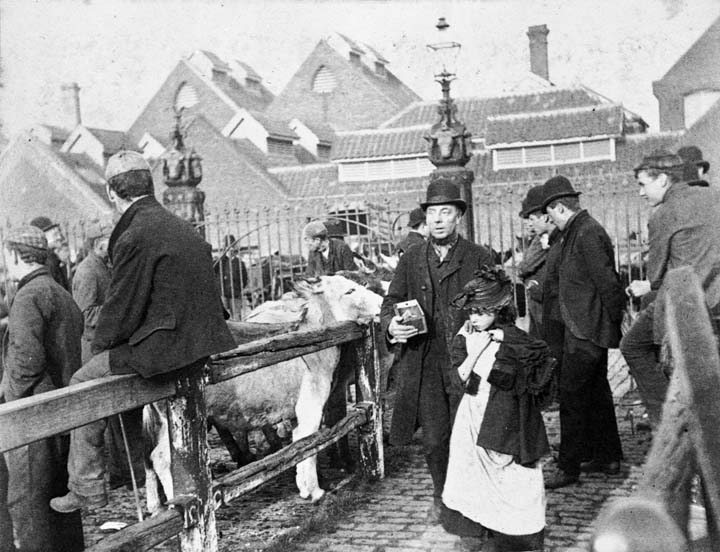
Blind man at the Caledonian Cattle Market, c. 1895 by Paul Augustus Martin
A man carries milk bottles through an unidentified street by Margaret Monck
I'd also be interested to see any work of the many "Anonymous" photographers documented in the book too. In particular I'm fascinated by these four images entitled "Shoppers in Sutton High Street, c. 1930".
Shoppers in Sutton High Street, c. 1930 by Anonymous
Apart from the period in which they are taken, which is of particular interest to me, I enjoy the relative incongruity of their location. A popular history of street photography would place these in New York or Paris, even Moscow. Sutton, UK doesn't quite fit the received narrative.

I hope the Museum of London's new exhibition seizes the opportunity to present an alternative perspective. One which challenges the notions that this style of photography is new to London, transplanted from continental Europe and the States, and practitioners such as Roger Mayne and Tony Ray-Jones are exceptional rather than part of a continuing tradition.

30 Aug 2010

on show - Museum of London

I've been invited to show one of my images at the Museum of London's London Street Photography exhibition opening next February. It's a fantastic honour as, obviously, London is so close to my heart and the Museum, in particular, is one of my special places.

The image selected was made around 1989 which, in retrospect, was a really productive period of my work. Post-NYC, pre-children I had the luxury of time, but no money, to indulge myself coming to terms with my return to London.

link to my Museum of London street photography show selection

It's ironic in that one comment made of my pictures is how hard it is to identify their location and date. For me that's as much about our pre-conceptions of how images of London, or contemporary London for that matter, should look, so I'm really intrigued to see mine in the context of a historical survey.

17 Jun 2010

urban encounters: Berlin trams and London bookshops

Last month's event at Tate Britain,Urban Encounters: Routes and Transitions, was a great opportunity for me to consider street photography, and my work in particular, in the context of others who are stimulated by urban environments. The participants were drawn from a spectrum of writers and practitioners, from the UK and internationally. Under consideration were themes of migration, location and memory and they were each explored from personal experience rather than purely theoretically.
Urban Encounters: Routes and Transitions

The main speaker was Camilo Jose Vergara, a photographer who was new to me. He showed his most recent project on the streets of Berlin, in particular an extended sequence where he took a fixed position inside a tram and photographed people as they entered. It was interesting to me as it's a direct contrast to my own approach of constant movement, opening myself to the random collisions and coincidences of people and their immediate environment. However by setting strict parameters around a subject, literally a door frame in this instance, a kind of levelling arises by removing them from any indicators of their social status and placing them in a situation of immediate common purpose i.e getting on a tram. This democratisation is in itself an interesting concept in the light of Berlin's recent history. In spite, or perhaps because, of this it was hard to resist projecting a narrative onto the individuals portrayed. Clues of of their appearance suggested their "real" lives.
When I think of taking this approach to my own work I find that the presence of the urban environment, the shop doorways, bus stops and pavements, the fabric of the city, is as much a part of the scene as the individual. It's that ongoing negotiation that intrigues and excites me. Still, that shouldn't stop me from trying something new!
Another comment of Camilo Jose Vergara that struck me was his determination to have his work published in print. It arose principally from a concern of the long-term viability of digital recording, archiving and retrieval. As I sit here committing these thoughts to a system now owned by a global corporation with no obligation to continue to provide this service, for free, in perpetuity, I'm thinking I really should move this site onto WordPress or Posterous! Seriously it's a salutary reminder of how quickly the words photography and digital have become synonymous. Ironically I've found the route to commit my, what's come to be known as, analogue work to print by using a purely digital process. 
I have explored traditional printers for quality of reproduction but the print-on-demand and distribution benefits of Blurb, minimal commitment with maximum reach, are more attractive for me at the moment. It's easily characterised as vanity publishing, but there is something in the concept of preservation that justifies it to me. Preservation for whom is another question but the idea of time capsules has always fascinated me. There's a great second-hand bookshop I visit and I always enter it with a sense of adventure, and it's as much about the sensation of handling books printed fifty years ago or more as finding any undiscovered gem. Even with the half lives of our digital footprints c/o Facebook etc  I'd like to think there's still a place for an artifact, something that can speak of us and our experience that can be witnessed in the future. Perhaps I've been listening too much to A History of the World in 100 Objects!

31 May 2010

the price you pay

What's the cost of street photography? Street photography is for me a self-initiated, self-indulgent, self-financed act. Part of the tension I bring to my work is that desperate pull between the worlds of earning a living and the intoxicating state of creating work for its own sake.
This issue was really brought home to me while reading the book by Sam Stephenson of The Jazz Loft Project featuring the images of W. Eugene Smith. In essence it's a document of the life and times of that photographer in a New York City of the late fifties, early sixties where the jazz scene defines my perception of the romance of that world, however misguided.
Ironically the words and the image that I responded to most were the references to his family life...
...Smith was thirty eight years old and at the top of his profession. But he was suffering through a harrowing stretch in his personal life. His misery made may of those closest to him miserable in turn. He had four children and a wife living at his home in Croton-on-Hudson, and another child living with a lover on Philadelphia. He virtually abandoned all of them when he moved into 821.
...In a 1976 interview he [Smith] recalled the time around 1958 as his peak as a photographer but his nadir as a human being: 'My imagination and my seeing were both - and I don't know if I can think of the right term - red hot or something. Everywhere I looked, every time I thought, it seemed to me it left me with a great exuberance and just a truer quality of seeing. But it was the most miserable time of my life'.
In the book, among the many of known and unknown jazz musicians of the day, there is a photograph of his daughter Shana in the stairwell outside the loft itself.
W Eugene Smith Jazz Loft Project
Jazz Loft Project, W Eugene Smith
This photograph really made me pause for contemplation of that moment and that gaze between father and daughter.
Such sacrifice is not for me. The price is too high. I can remember walking the streets of Shibuya in Tokyo, camera in one hand, a bag of toys in the other, and thinking 'I'm sure William Klein didn't do this...'
However I can't escape the question that by not "following the dream", that talisman of self expression, is my work never going to be good enough? Good enough for whom? Maybe good enough just is...

6 Apr 2010

"loved; life; London" review

My first book loved; life; London is reviewed in the Spring issue of fLIP, the magazine for London Independent Photography. Here's a preview of some of the images and it can be purchased online.

loved; life; London preview

I'm particularly proud as the members of London Independent Photography share a passion for the city and it's a privilege to be included in the magazine. 
To any reader who buys loved: life; London I'd like to offer a free copy of my second book Portrait of a Street Photographer.
Please email me first at sean@waysofwalking.net for more details!