One of the topics raised in my street photography talk at Photofusion last year was the approach of setting yourself a project as a street photographer, working to rules, taking pictures for a particular purpose, versus a more aimless, wandering style. I'd originally, and a little arrogantly, put myself in the latter category.
Setting limits surely contradicts the whole ethos of street photography? The romantic tradition of the flâneur predicates a reckless abandon to chance. There's no plan of action or premeditation. Everything has equal significance before the steady gaze of the impartial, impassioned observer.
Well, with a little more thought on my part, and the purpose of this website, despite those ambitions I have a number of conditions surrounding my work that mean I do not so neatly portray the free wheelin' style of the boulevardier.
And, as is the fashion of the web, I'll turn them into a list (and include yet another gratuitous French reference).
I've now come to a point where I'm thinking about people. Who do or don't I take pictures of?Recipe for Street Photography à la Sean McDonnellSeason well and simmer for 25 years, stirring occasionally.film35mmblack & whiteHP5SLROlympussingle lensfixed28mm1/500f16blindLondonWest Enddaytimeweekdaysoutsidenatural lightsunshinepeople
don't go back
The mélange of social classes is a defining characteristic of street photography. What attracts me to London's West End in particular is that mix of shopper, worker, student, tourist, day tripper, native (and all the subtle classifications between) thrown into eachother's company.
However the privileges of the city are granted by invitation only. London's better than a lot of cities but access and navigation for the less physically able is restrictive. The explicit and implicit presence of authority and surveillance, encourages a conformity of appearance and behaviours and, by implication, draws attention to and discourages those who deviate. Flipping this around I can't ignore the corresponding position I hold as a single, white, male on the street; one of the silent, invisible, majority, able to go about his business with relative impunity.
When I look at my work I like the diversity of people I see. I feel proud that London is a city where, in spite of the reservations I've touched on, it is a city to roam. However I'm mindful that freedom, and the freedom to record it, is hard won and precious.
Well I don't quite know how I've ended up talking about liberty, equality and fraternity...but then again perhaps I do.
À bientôt, mes amis!
23 Jan 2011
the reluctant flâneur

5 Jan 2011
new year, new book
My collection of images I called The Distance Between Us came into being over a year ago. While revisiting my work, I began to saw a number of photographs with two figures interacting with one another through a gesture, eye contact or just being in close proximity to one another. Some of those interactions were obviously intended by both parties, others were not. What interested me was their record of moments that we are all party to, throughout our public lives on the streets. The effect of sharing public space with a random cross-section of others means we experience a level of intimacy that I think is worth cherishing.
I was content to let these pictures live together as a stack of prints. I'd just published two books and wanted to absorb the process and consequences of that. However at the end of last year I felt ready to think about how they could be presented on the printed page.
My original book loved; life; London follows the traditional approach of a monograph: same-size images sequentially presented as they'd appear on a white gallery wall. The second, Portrait of a Street Photographer, is an attempt to put the photographs into the context of why they were made. To reflect the street experience different layouts are used to give the book a rhythm and dissonance. My new book, The Distance Between Us, develops that approach and deliberately presents the images in a fractured way. It's not a printing error!

The decision to use this approach was influenced I confess by the new pocket book format that Blurb have released. It's not a friendly format for full frame 35mm street photography but using the dimensions of the pages to determine the crop and arrangement of the images felt natural and in tune with the ideas behind this particular collection.The paper stock is certainly not for the purist but, again, I feel it complements the nature of these pictures and they add up to something greater than the sum of the parts. Hey, I think I've another book title...
4 Dec 2010
street photography talk at Photofusion
I was fortunate enough to be invited to talk to a group of street photographers at a course run by David Gibson of In-Public at Photofusion in London last week. It was the first time I'd done something like that and I certainly hope those on the receiving end enjoyed it as much as I did.
In the spirit of this website I wanted to convey "the how" and "the why" of my work as much as the end product, the picture itself.
Preparing the talk lead me to review my work in a chronological way. Surprisingly to me, but perhaps inevitably, I couldn't separate it from my own journey, from the certainty of youth to the less than certainty of older age.
If you're interested you can see the pictures I talked about at the bottom of this entry.
I wanted to break up the presentation of my images with ideas that gave a little more background to my state of mind at the time so, before you look at them, I'll explain some of the more random ones...
I characterised my pull to the febrile atmosphere of New York City through the images of David Byrne, an icon of the New York art/music scene, and Telly Savalas, an icon of my misspent youth watching TV, the New York City detective Kojak. I could have gone on to include Andy Kaufman from Taxi and Gene Anthony Ray from Fame but I think I got the idea across...
The technique I'd developed, more by accident than design, was releasing the camera's shutter away from my body, requiring a degree of hand-eye coordination. Who better than the tennis player John McEnroe to represent that? Then, sticking with sporting metaphors and perhaps pushing them too far, I chose an image of the great Austrian skier Franz Klammer to represent my physical approach on the street of moving at speed but with control. Make sense? No, perhaps only to me.
The other images I've chosen are those of Shane McGowan and Viriginia Woolf. I admit I liked their juxtaposition but they also helped illustrate the part of my story where I've been influenced by musical and literary work.
The final pictures represent photographers I particularly admire. There are so many I could include but I chose these for my audience, ones which perhaps are not so obvious: Roy DeCarava, Ray Metzker, Daido Moriyama, Sylvia Plachy and Michael Ackerman.
You can certainly include Don McCullin in that group too. A photograph from his book Homecoming opens my talk.
There were some very good questions and comments which were really interesting for me, not having gone public in such a way before. I'll pick those up next time.
26 Oct 2010
lost London street photographers
I've recently re-visited Mike Seaborne's book "Photographers' London: 1839-1994" and it's made me curious about the content of the Museum of London's street photography show next year. The book features a number of photographers who recorded street life in a variety of styles who've had little recognition in the surge of interest in the genre in recent years. For example it would be great to see references to people such as Paul Martin and Margaret Monck.
Here are examples of their respective work courtesy of two great online resources, photoLondon, now no longer updated but still useful, and Exploring 20th Century London.
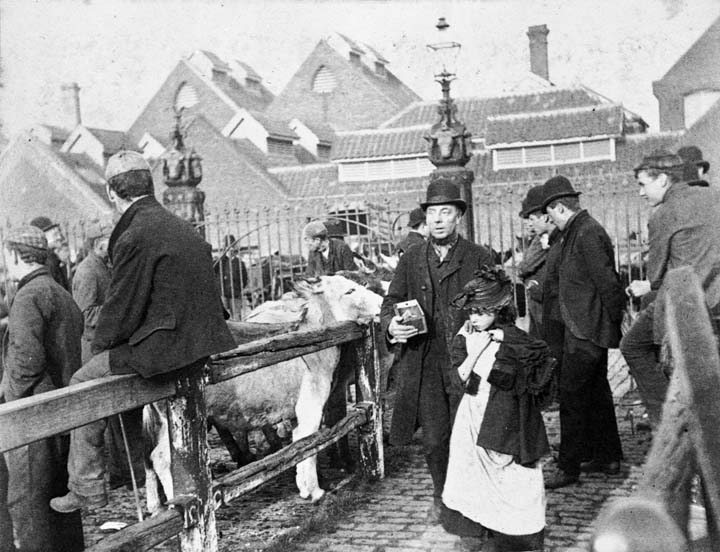

I'd also be interested to see any work of the many "Anonymous" photographers documented in the book too. In particular I'm fascinated by these four images entitled "Shoppers in Sutton High Street, c. 1930".

Apart from the period in which they are taken, which is of particular interest to me, I enjoy the relative incongruity of their location. A popular history of street photography would place these in New York or Paris, even Moscow. Sutton, UK doesn't quite fit the received narrative.
I hope the Museum of London's new exhibition seizes the opportunity to present an alternative perspective. One which challenges the notions that this style of photography is new to London, transplanted from continental Europe and the States, and practitioners such as Roger Mayne and Tony Ray-Jones are exceptional rather than part of a continuing tradition.
30 Aug 2010
on show - Museum of London
I've been invited to show one of my images at the Museum of London's London Street Photography exhibition opening next February. It's a fantastic honour as, obviously, London is so close to my heart and the Museum, in particular, is one of my special places.
The image selected was made around 1989 which, in retrospect, was a really productive period of my work. Post-NYC, pre-children I had the luxury of time, but no money, to indulge myself coming to terms with my return to London.
It's ironic in that one comment made of my pictures is how hard it is to identify their location and date. For me that's as much about our pre-conceptions of how images of London, or contemporary London for that matter, should look, so I'm really intrigued to see mine in the context of a historical survey.

Subscribe to:
Posts (Atom)