Another summer break, another excuse to try something different.
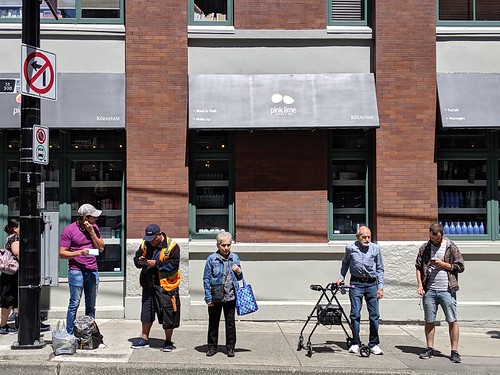
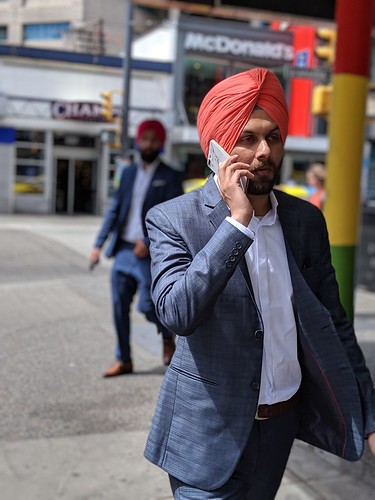
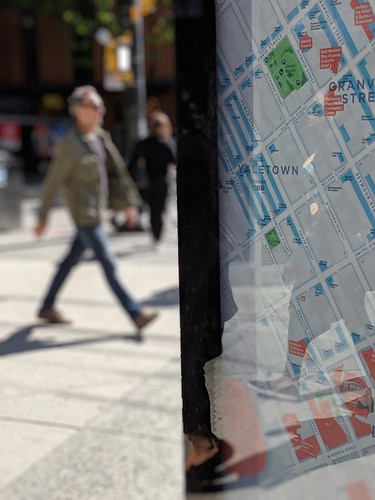
For good or ill I'm finding it hard to disassociate my black and white street work on film from my New Europe project. Using my camera has become synonymous with a certain way of working (which I've commented on at length!) so a trip to North America was an opportunity to use mobile/digital/colour in a new way.
This combination actually got me started again in London a few years ago after a quiet period. Perhaps it was the more relaxed vibe of the city but I wasn't driven in the same way in Vancouver as I am in other cities. It made for a more deliberate approach which for me is not a bad thing.
I've shied away from this style as I - arrogantly to be honest - find it hard to make it individual to me and not too generic. However using a mobile phone without changing any settings pre or post let me work in the fluid way I enjoy with my camera (that in the momentthing) and feel more excited about the making process as well as the resulting picture. Yes I still like to see them as two separate parts!
I like the results. The images themselves are a - small - change in direction but they also represent a way of working I should consider in London too.
They are still one-off pictures in a travelogue style but in the same way I've built a narrative around my more recent work it's perhaps a way of looking at other ideas. Short stories, not novels.
My photo group was recently set a challenge to choose our Desert Island Pics.
If you're not familiar with the phrase it's based on there's a nice summary
here.
As
I'd be thrown by choosing 8 pieces of music then 8 photographs was I'd say even
harder. The format of the show is to tell the life story of the guest and the
music often relates to particular moments so I chose to pursue that approach
rather than select a set of fantastic images that really didn't mean anything
personal to me.
That
said I did look at family snapshots as very much part of my story. An
interesting point of departure from the music route as I've rarely heard home
recordings selected.
Anyway.
Where to start?
Well
as I've mentioned before growing up in front of a black and white TV gave me a
particular perspective on the world. I do remember old American comedies -
excuse me movies - broadcast on Saturday mornings: Laurel and Hardy,
Buster Keaton etc so I've chosen a famous still from a film by Harold Lloyd. I
love the view of the city below. It obviously adds to the drama but for me it's
a window on the everyday world below. In retrospect - I'll be doing a lot of
that here - it plants a seed for my interest in America and cities in
particular
Harold
Loyd in Safety Last!, 1923
I
can't leave this period with acknowledging film noir. There are so many to
chose from but this is a memory from a Sunday afternoon. We're in front of the
telly again. Turned down low while my mum and dad rest after their working
week. On comes a film set not in Chicago or Pittsburgh but in Belfast. The
atmosphere is tense. We're following an individual in real time with odds
stacked against him. The city has a personality of its own, Swaying
passionately from violence to humour. I'm transfixed. It's called Odd Man Out
by Carol Reed starring James Mason. Watch it.
James
Mason in Odd Man Out, 1947
OK
so now I'm a little older. My first time living away from home. I've a bedroom
wall to decorate. What do I put on it? Pop stars? Political manifestos? Family
photos? Nope. Pictures of sports photography cut out from the newspaper and
mounted neatly on card. Yep. What can I say.Eamonn McCabe was the premier sports photographer of the time and I
remember looking forward to seeing his pictures in the Sunday paper. Here's one
of Bjorn Borg that was on my wall. although I must admit to fancying myself as
more of a McEnroe.
Bjorn Borg, Eamon McCabe, 1978
Doing
this exercise now it's interesting how significant photography was in my
upbringing but how I made no real effort to pursuing it as a career. Put it
down to an academic education, absence of any peer support or simply lack of
self belief. Anyway next pic. Sorry for the self reflection but hey it's my blog.
We're
now in Leeds and there are two images I've chosen to represent that period in
my life. Apologies still back and white. We're going back a bit but I believe
colour had been invented by now.
I
never saw The Clash (although Mick Jones played an important part in my later
life) let alone any bands I should have done in that tumultuous era. However I
did buy the album! Two in fact as the were selling for 99p each in a bargain
bin and I gave one to my friend Paul. This is getting very Adrian Mole. Here's
the cover photograph by the great Pennie Smith.
London Calling, Pennie
Smith, 1979
I
remember the university library at Leeds had two photography books, Minamata by W Eugene Smith and the other was I think by Don McCullin. By now I'd started taking
photographs around Leeds with my first proper camera a Zenit and my style
evolved with what I saw around me. Bradford wasn't far away and at the time the
National Museum of Photography, Film & Television had recently opened
there so my self-education continued inside those walls and outside on the
streets surrounding it. McCullin's work had particular resonance and I devoured
his work to the point of forfeiting my fare home to London to buy his book on
Beirut.
Bradford, Don McCullin, 1979
So
my life took another turn after Leeds and the fulfilment of a dream to see New
York City. Music was again a stimulant. Seeing Stop Making Sense at the Hyde
Park Picture House wasn't quite Buzzcocks at The Free Trade Hall but the
spectacle of David Byrne propelled me to go.
David Byrne in Stop Making Sense, 1979
I've
chosen two photographs to represent my time there.
The Village Voice became a
staple read for me every week and the work of one photographer in particular
stood out. Sylvia Plachy's Unguided Tour column eloquently captured the energy,
madness and passion of the city around me.
Unguided Tour, Sylvia Plachy
At the time I still really hadn't discovered the canon of street photographers
that are now so well known. My education was browsing book stores and going to
see exhibitions and at that time there wasn't a great deal on offer. One day a book
called Invisible City caught my eye. The photographer was Ken Schles. As Plachy
represented an exuberant exterior life of the city Schles refracted an
underground perspective that I was also conscious of.
Invisible City, Ken Schles
Oops. I've got to 8 and I'm just into my twenties. I knew this would be tough. So what's this telling me? Well after that period I settled into developing the
style of work you see today and is actually picked up at the start of this blog. Would I choose some of my own work - public and private - to represent
that later period in addition to other photographers? I certainly think so.
All the pictures - except one - are black and white. I need to keep breaking that up. In addition only two pictures are by women and they're all from a white western
perspective. I think my later selections would have a range of far richer source as I keep learning about new photographers and practices.
So I could have picked the most influential, well known photos over the same
period but I think sitting on my desert island, wondering what on earth I'm
going to cook for supper, looking at these particular images will kindle some
important memories.
Excuse me while I choose the next 8 and see if I can smuggle
them with me too.
I'm always interested in work of Irish photographers so I was really pleased to see Eamonn Doyle and his collaborators speak at Photo London last week, just after I discovered The Republic by Seamus Murphy. I'm shamefully late finding out about Murphy's work so I have to thank Ben Smith's Little Voice podcast. Recommended listening.
Each of their bodies of work are fascinating - and timely - for me. As well as my ongoing project on European citizens, this year's show for my local photography group is on the theme of Home which I'm using as an opportunity to think about my own roots.
My mum Kate passed away two years ago. A migrant from Galway in the 1950s as my dad was from the north of Ireland it was a given for me that she'd be buried in the place she was born and raised in. The word home was always understood in our house as Ireland. On reflection it's an obvious sign of the dislocation of our lives.
To portray that in a single image presents a challenge, for me at least but hey it's one of the reasons for joining the group. I could look at constructing an image, perhaps a still life of an object, to symbolise my emotions. Perhaps it's more of a collage of different elements. Yesterday I heard a word I hadn't in a long time. Kaleidoscope. It really brought back a memory of one I had as a child. As well as the act of losing oneself in a miniature world of shifting shapes it had a maracas-like quality when you shook the little crystals inside. Simple pleasures.
An alternative route, inevitable in a way, is a landscape image. I say inevitable as land has both political and personal resonance, as it has I'd guess for many emigrant people. It's the place you left and yet it still has a magnetism that draws you back, sometimes despite yourself.
I've taken landscape before as holiday snaps, scenic views for the record, with a visual language of fine art oil paintings. None that I ever feel really engaged in the way I do my city pictures. Too proud a townie to be bothered with nature. Perhaps it's time to revisit that.
Murphy's book is inspiring for me in this regard. I just needed to see the cover image and it was interesting to hear him talk about that on the podcast as it appeared at a moment when he had real doubts about continuing the project, about his work being good enough to justify its subject. Like a vision he came across this particular stretch of road - that he could never find again - and he was on his way.
Doyle's work really made a splash about five years ago and I was really pleased to see the manner of how he presented his work firstly at Arles and now when I saw it in London. I've considered how to present urban/city/street work and never felt comfortable with a purist white wall gallery experience. In fact my first effort back in the late 80s was at a former synagogue in Spitalfields where I photocopied and pasted my pictures across sheets of re-purposed corrugated iron in the basement. A reasonable DIY first attempt at an installation but writing this now has really made me think of what more I could (still?) do.
I wasn't aware, ignorantly, again, of K a subsequent project by Doyle inspired by the death of his mother Kathryn. It's in a way figurative but certainly of the landscape as well. The result is an imaginative contemplation of a woman's life. Something personal but co-created with two friends as a multi-sensory piece of work.
So all in all a timely - as always - intervention of art and life. I wonder if photography for me is less about making sense of the world around me and more about making sense of myself. Or does everyone think that. Do you?
I've just experienced the most remarkable evening of photographers discussing their work. A new initiative called the Photojournalism Hubbrought together Rob Pinney, Giovanna del Sarto, Tavis Bohlinger and James Hopkirk to tell the stories of their work. They each well met the ambition of the evening to expose and engage pressing social justice issues through committed and courageous photojournalism.
Refugees' experiences connects the work of Rob Pinney and Giovanna del Sarto but each of their approaches are distinctive. Pinney's searingly honest description of his initial emotions at The Jungle in Calais and the evolution of his work as he became more familiar with the people - camp refugees and town residents - and their codes of behaviour was fascinating.
Del Sarto's work explores the power dynamic between photographer and subject, turning it around in her Polaroid for a Refugee project. Recognising the significance of family photographs in the journey into the unknown, the act of taking - then giving back - an image with the commitment to follow its path is incredibly powerful.
The next story took us inside a very personal reflection by a father on his son's journey with autism and epilepsy. Tavis Bohlinger's The Epileptic felt like a real time commentary on his emotional struggle in dealing with what was happening to his son by having the presence of mind - such an apt phrase - to make a photographic record of his interactions with health carers. Using them to interpret the impact on his son of this process was both harrowing and insightful and, as someone with family impacted in the same way, thought-provoking.
The final story was another dimension to the refugee journey, that terrible period of uncertainty once arrived of being granted permission to remain. The Blood of a Woman by James Hopkirk is far more than a documentary project. His involvement with the issues raised by following the story of Mirela cross the traditional boundaries of the objective photojournalist but for me represent a far more humanist approach than the questionable practices of some contemporary photographers.
Do spend time with each of these stories. They are all inspirational.
Well I've enjoyed my 15 minutes of fame this week c/o a post on Instagram and a chance (more of that later) meeting with Matt Stuart outside Tottenham Court Road station.
I first met Matt many years ago when he - and others - were conceiving In Public arguably the first collective of street photographers. I was oblivious to the fact that I was the subject of a selection process for the group and had simply appreciated the chance to meet some like-minded souls! In a nicely circuitous way I've now found myself recognised under the flag of new name of the group Un Public whose Instagram account Matt's currently curating.
I was really interested in Matt's selection of a set of images from my website. Of the 10 only one is recent and to be honest does "fit" well with the older ones.
Without dwelling on it too much - as if - it's a useful piece of insight into how I'm trying to develop my work with the New Europe project and how I can balance those standalone images with less obvious ones that are developing that story.
Oh yes. Chance. Yes I'd seen that Nick Turpin, the other driving force behind In Public was in town the same day and thought about trying to meet up with him but in the end found myself on Oxford Street with a real sense I was going to see someone. Well my street photography diving rod was obviously on to something when I saw Matt.
I've been pursuing a style of photography now called street for a number of years. A south Londoner by birth I am pre-occupied with the West End and spend too much time there taking black and white pictures on film.
I nurture a hope that one day London will be recognised like Paris, New York and Tokyo as a great city of street photography but secretly like the fact that it is still the underdog.
For someone who enjoys the solitary practice of his work I am surprisingly talkative about it - although not at the same time.
Here's a collection of idle musings and distracting links. If anything catches your eye drop me a line at sean@waysofwalking.net