skip to main |
skip to sidebar
The announcement by London's police force that it will use live facial recognition reminded my of a book I published a few years ago called Street View People View

The arguments against it are essentially the same (although the quality of the technology is still moot) but what's changed is the sense of threat to personal safety on the streets of London. It's well documented that London is, outside China, the most cctv'd (if that's a word) city in the world which I think has normalised (not a nice word) surveillance here. I'm certainly conscious of its absence when I visit other cities around Europe.
I'm also conscious that street photography is itself a form of surveillance. I've excused myself with the well worn argument that anyone - voluntarily - in a public space is open to being photographed. I must admit even writing this now makes me stop and think. I find myself thinking of clauses like some dodgy small print.
My pictures take months to produce so I don't share them randomly with my thousands (sorry, tens) of followers
They are on film so there is no exif data of specific time and place
People are in my pictures but the subject is the city
It's not about you...it's about me
etc etc
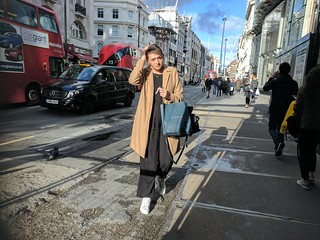
I acknowledge my work is becoming more anachronistic the longer I pursue it. The universal truths of earlier practitioners appear naive or repressive now. Street is still a valid form but it needs to reflect the present to work best, as it's always done. The New Europe project is my attempt to address that. It's given me greater motivation and purpose. It's also given me something else.
Empathy.
Well the summer 2019 results are in and I must admit to feeling underwhelmed. The patchy weather after the excesses of the spring didn't help but I never felt I got in the groove all summer. Kept missing the beat.

It's not surprising in some respects. I've tried to move away from that high contrast morning or evening sunlight raking across the West End silhouetting figures or exposing them to a brutal blinding beam. I've become more interested in the environments, social and emotional, around people. It's not about finding juxtapositions. More about taking a step back. Thinking a bit about context. It could be the news or something more personal. The consequence is a more deliberate, less pacey style. Snooker not slalom.
I don't think that's about losing the physical drive. It's an evolution of my style that really started after my break a few years ago that led to the New Europe project. It becomes evident when I look at my contact sheets. Now it's less obvious to see the ones to take on to print, there's fewer obvious "keepers" (forgive me). My rate of return is less but I'd like to think the images have greater depth, especially when seen in the company of others. I've tried to express it in the re-looking part of my 5 Acts approach.
Where does it leave me? I seem to say this every year but end up feeling like a football fan looking forward to the next season. It's not the despair, it's the hope that kills you. So the cliche goes. Roll on 2020.
It's that time of year for me to enjoy the guilty pleasures of the photobooks I've picked up over the years. I say guilty as they do feel like an indulgence. Often bought on a whim, they still serve as an inspiration. I don't have a most wanted set and I don't really keep up with the latest releases, apart from the ubiquitous lists at this time of year. I just tend to let them find me.
So it was with Krass Clement's Drum.
The circumstances in which the photographs were taken have a romanticism underpinned by a sense of absence and loss. Arguably that's a reflection of a lot of cultures not just Irish but it's one I have to say I identify with. The world depicted by the images evokes memories of not just back home but here in London in the world my dad and his compatriots recreated.
I was taken aback when I found the work was made in 1991. It's space borrowing time from another dimension. Ireland again. I recall the disorientation of entering bars - and homes - like that. A certain theatricality to the arrangement of the room, the order of who sits where, the silence.

It's interesting how much the analysis I've read is about the photographer's empathy with the others in the bar. Each an outsider in their own way. A form of reflective photojournalism. Not judging. Observing a ritual.
Bearing witness.
I've known the powerful images from Roger Mayne's Southam Street series for a long time and was honoured to be shown in his company at the survey of London Street Photography show a few years ago. Made at a time in London's history when my parents had arrived to be confronted by a culture of "No Blacks, No Dogs, No Irish" his pictures have a social context that give them an added edge for me. I had a real thrill when - oh what's that word? Oh yes - serendipitously, I came across the street sign while out walking beneath Trellick Tower, one of my London icons.
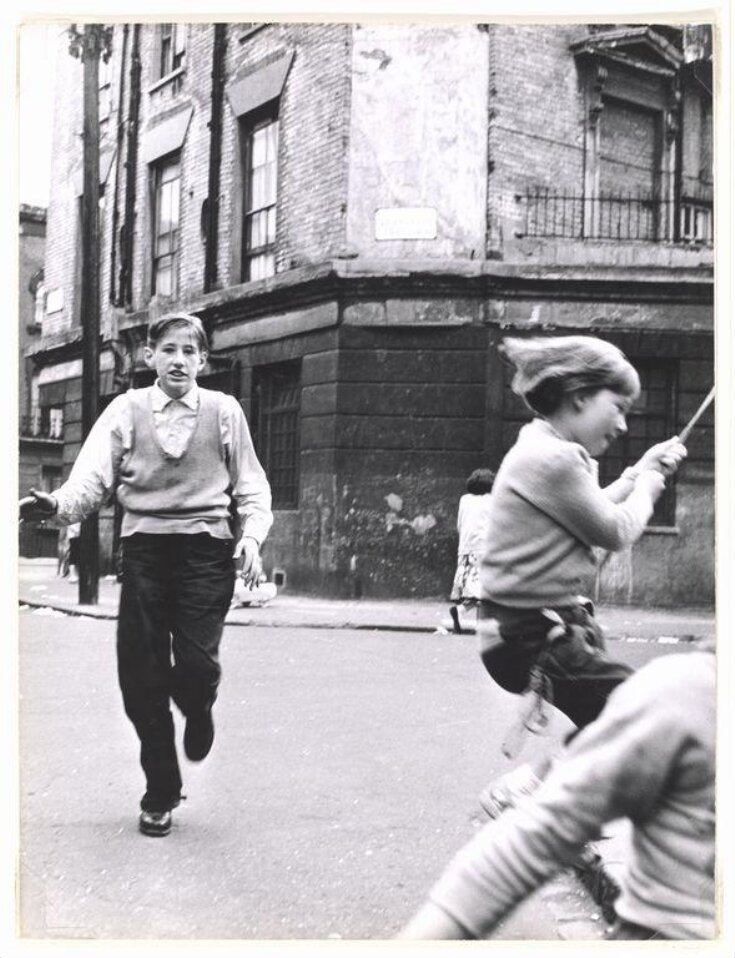
Southam Street, W10, Roger Mayne
I say sign because the fabric of the street has all but disappeared save two buildings looming like Warner Brothers film lot facades. Those terraces and sounds can now only be experienced in social documentaries of the era. I know I'm in danger of a nostalgia wallow - which could be said of my whole practice - but it's interesting to read Mayne's own words from 1959,
The reason for photographing poor streets is that I love them. Empty, the streets have their own kind of beauty, a kind of decaying splendor and always great atmosphere - whether romantic on a hazy winter day, or listless when the summer is hot; sometimes it is forbidding; or it may be warm and friendly on a sunny spring weekend when the street is swarming with children playing, or adults walking through or standing gossiping. I remember my excitement when I turned the corner into Southam Street, a street I have since returned to again and again.
It's hard not to avoid a comparison with Cartier-Bresson's privileged upbringing and subsequent love of photographing everyday life. Granted having the time and money to pursue this way of working for its own sake was - and arguably still is - a characteristic of street photography but should it have any bearing on judging its merit from our perspective?
I'd go back to my opening point that I take as much from the social context of street images as their own composition. You could say that's not untypical of any photography but for me it's particularly relevant to street which by its nature is a real time reflection of both the location of the photographed and the culture of the photographer.

So where are the Southam Streets of today? Well there are still plenty of poor streets but people are now documenting their own lives, spending as much time on written narrative as the image. Jim Mottram and Paul Sng are two notable examples and I'd also include James Hopkirk too.
The images speaks with originality and energy, giving insight into worlds too easily neglected. The photographer here is no longer bystander or daytripper but implicated and yes exposed by the work.
I was on that journey too once upon a time. Time bends.
Visually, with digital technology we’re actually coming closer to nature...If you look at anything natural under a microscope, it breaks down into fractals. And we are now looking at the world in fractals, through pixels, rather than a halftone, which is how we used to see images with print. Michael Stipe
I like the literal layers of these ideas, meanings uncovered as I read. I can see how digital brings us closer to nature in a literal sense. Does it leave room for mystery? Granted that's another word for ignorance or superstition or delusion and we're in the age of a second renaissance right?

I'm not about to rehash a digital versus analogue debate but having worked with both media I'm still drawn to the less than definitive qualities, the halftones, the half truths of film and print. They reflect my take on the world and as I've written about - at length - the ambiguities I enjoy.